Toyota Yaris: Interior Equipment / Storage Compartments
WARNING
Keep storage boxes closed when driving
Driving with the storage boxes open is dangerous. To reduce the possibility of injury in an accident or a sudden stop, keep the storage boxes closed when driving.
Do not put articles in storage spaces with no lid
Putting articles in storage spaces with no lid is dangerous as they could be thrown around the cabin if the vehicle is suddenly accelerated and cause injury depending on how the article is stored.
NOTICE
Do not leave lighters or eyeglasses in the storage boxes while parked under the sun. A lighter could explode or the plastic material in eyeglasses could deform and crack from high temperature.
 Bottle Holder
Bottle holders are on the inside of
the front doors.
NOTICE
Do not use the bottle holders for containers without caps. The contents
may
spill when opening/closing the door or while driving the vehicle...
 Overhead Console
T..
Other information:
Toyota Yaris XP210 (2020-2026) Reapir and Service Manual: Left Front Wheel Speed Sensor Signal Stuck Low (C050023)
DESCRIPTION Refer to DTC C05001F. Click here DTC No. Detection Item DTC Detection Condition Trouble Area DTC Output from C050023 Left Front Wheel Speed Sensor Signal Stuck Low Any of the following is detected: When the +BS terminal voltage is 17...
Toyota Yaris XP210 (2020-2026) Reapir and Service Manual: How To Connect Or Disconnect Airbag Connector
HOW TO CONNECT OR DISCONNECT AIRBAG CONNECTOR PROCEDURE 1. TYPES OF AIRBAG CONNECTOR (a) Types of Connector TYPE Shape (Example) Pull Up Type 2-Step Lock Type Slide Lock Type 2. DISCONNECT OR CONNECT AIRBAG CONNECTOR (for Pull Up Type) (a) Disconnect the connector...
Categories
- Manuals Home
- Toyota Yaris Owners Manual
- Toyota Yaris Service Manual
- Headlights
- Power Integration No.1 System Missing Message (B235287,B235587,B235787-B235987)
- Brake System Control Module "A" System Voltage System Voltage Low (C137BA2)
- New on site
- Most important about car
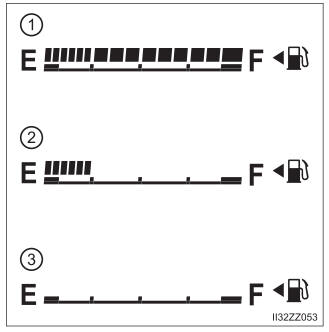
Fuel Gauge
The fuel gauge shows approximately how much fuel is remaining in the tank when the ignition is switched ON. We recommend keeping the tank over 1/4 full.