
Toyota Yaris: Hood / Disassembly
Toyota Yaris XP210 (2020-2026) Reapir and Service Manual / Vehicle Exterior / Door / Hatch / Hood / Disassembly
DISASSEMBLY
PROCEDURE
1. REMOVE HOOD INSULATOR
| (a) Remove the 4 clips. |
|
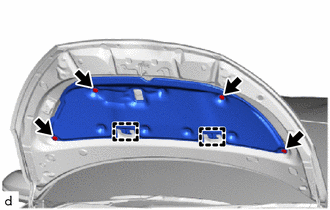
(b) Disengage the guides to remove the hood insulator.
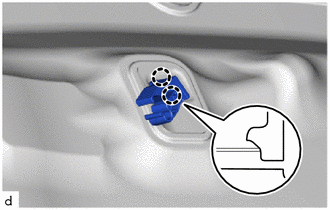
2. REMOVE HOOD STAY HOLDER
| (a) Disengage the claws to remove the hood stay holder. |
|
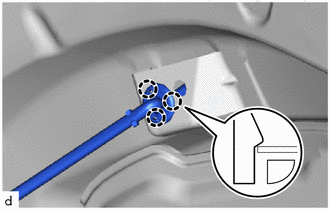
3. REMOVE HOOD SUPPORT ASSEMBLY
| (a) Disengage the claws to remove the hood support assembly. |
|
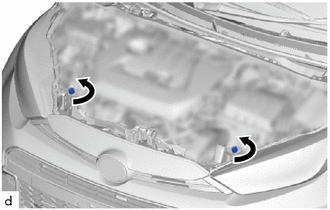
4. REMOVE HOOD BUMPER CUSHION
| (a) Rotate counterclockwise to remove the 2 hood bumper cushions. |
|
 On-vehicle Inspection
ON-VEHICLE INSPECTION PROCEDURE 1. INSPECT HOOD SUB-ASSEMBLY (a) Check that the clearance measurements of areas "A" through "E" are within each standard range...
 Adjustment
ADJUSTMENT CAUTION / NOTICE / HINT
*a Centering Bolt *b Standard Bolt HINT:
Centering bolts are used to install the hood hinges and hood lock...
Other information:
Toyota Yaris XP210 (2020-2026) Reapir and Service Manual: Inspection
INSPECTION PROCEDURE 1. INSPECT MASS AIR FLOW METER (a) Perform a visual check for any foreign matter on the temperature sensor (thermistor) of the mass air flow meter shown in the illustration. OK: There is no foreign matter. If the result is not as specified, replace the mass air flow meter...
Toyota Yaris XP210 (2020-2026) Reapir and Service Manual: Target Adjustment(triangle Target)
TARGET ADJUSTMENT(TRIANGLE TARGET) PROCEDURE 1. PREPARATION FOR MILLIMETER WAVE RADAR SENSOR ASSEMBLY ADJUSTMENT (a) Park the vehicle on a level surface where the area in front of the vehicle shown in the illustration is free of metal objects. *a 5 m (16...
Categories
- Manuals Home
- Toyota Yaris Owners Manual
- Toyota Yaris Service Manual
- Fuel Gauge
- G16e-gts (engine Mechanical)
- How to connect USB port/Auxiliary jack
- New on site
- Most important about car
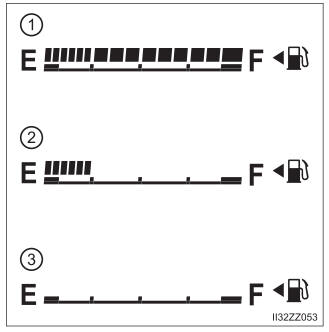
Fuel Gauge
The fuel gauge shows approximately how much fuel is remaining in the tank when the ignition is switched ON. We recommend keeping the tank over 1/4 full.

Copyright © 2026 www.toyaris4.com