
Toyota Yaris: Hood / Adjustment
ADJUSTMENT
CAUTION / NOTICE / HINT
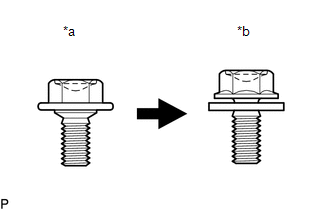
| *a | Centering Bolt |
| *b | Standard Bolt |
HINT:
- Centering bolts are used to install the hood hinges and hood lock. The hood and hood lock cannot be adjusted with the centering bolts installed. Substitute the centering bolts with standard bolts with washers when making adjustments.
-
The specified torque for standard bolts is shown in the standard bolt chart.
Click here
.gif)
PROCEDURE
1. INSPECT HOOD SUB-ASSEMBLY
Click here
2. REMOVE FRONT BUMPER ASSEMBLY
Click here
3. REMOVE RADIATOR UPPER AIR GUIDE PLATE
Click here
4. REMOVE HOOD SUB-ASSEMBLY
(a) Horizontally and vertically adjust the hood.
| (1) Loosen the 4 hinge bolts of the hood. |
|
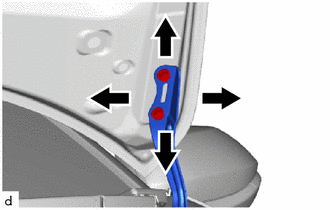
(2) Adjust the clearance between the hood and front fenders by moving the hood.
(3) Tighten the 4 hinge bolts after adjustment.
Torque:
13 N·m {133 kgf·cm, 10 ft·lbf}
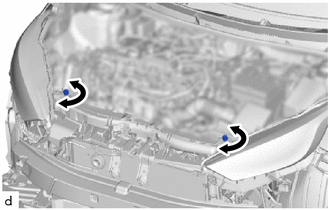
(b) Adjust the height of the front end of the hood using the hood bumper cushions.
| (1) Adjust the 2 hood bumper cushions so that the heights of the hood and fenders are aligned. HINT: Raise or lower the front end of the hood by turning the 2 hood bumper cushions. |
|
(c) Adjust the hood lock.
| (1) Loosen the 3 bolts. |
|
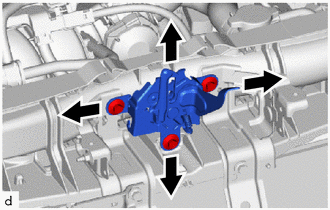
(2) Adjust the hood lock assembly and tighten the 3 bolts.
Torque:
11.5 N·m {117 kgf·cm, 8 ft·lbf}
NOTICE:
At the time of adjustment, use the supply hood lock assembly.
(3) Check that the striker can engage the hood lock assembly smoothly.
5. INSTALL RADIATOR UPPER AIR GUIDE PLATE
Click here
6. INSTALL FRONT BUMPER ASSEMBLY
Click here
 Disassembly
DISASSEMBLY PROCEDURE 1. REMOVE HOOD INSULATOR (a) Remove the 4 clips.
(b) Disengage the guides to remove the hood insulator. 2. REMOVE HOOD STAY HOLDER (a) Disengage the claws to remove the hood stay holder...
 Reassembly
REASSEMBLY PROCEDURE 1. INSTALL HOOD BUMPER CUSHION (a) Rotate clockwise to install the 2 hood bumper cushions.
2. INSTALL HOOD SUPPORT ASSEMBLY (a) Engage the claws to install the hood support assembly...
Other information:
Toyota Yaris XP210 (2020-2026) Reapir and Service Manual: ECM Power Source Circuit
DESCRIPTION When the ignition switch is turned on (IG), the auxiliary battery voltage is applied to IGSW of the ECM. When the transistor in the MREL circuit operates, current flows from the auxiliary battery to ground through the drive circuit of the EFI-MAIN NO...
Toyota Yaris XP210 (2020-2026) Reapir and Service Manual: Installation
INSTALLATION CAUTION / NOTICE / HINT NOTICE: When replacing the windshield glass of a vehicle equipped with a forward recognition camera, make sure to use a Toyota genuine part. If a non-Toyota genuine part is used, the forward recognition camera may not be able to be installed due to a missing bracket...
Categories
- Manuals Home
- Toyota Yaris Owners Manual
- Toyota Yaris Service Manual
- G16e-gts (engine Mechanical)
- Battery Monitor Module General Electrical Failure (P058A01)
- Fuse Panel Description
- New on site
- Most important about car
Break-In Period
No special break-in is necessary, but a few precautions in the first 600 miles (1,000 km) may add to the performance, economy, and life of the vehicle.
Do not race the engine. Do not maintain one constant speed, either slow or fast, for a long period of time. Do not drive constantly at full-throttle or high engine rpm for extended periods of time. Avoid unnecessary hard stops. Avoid full-throttle starts.