
Toyota Yaris: Hood / On-vehicle Inspection
Toyota Yaris XP210 (2020-2026) Reapir and Service Manual / Vehicle Exterior / Door / Hatch / Hood / On-vehicle Inspection
ON-VEHICLE INSPECTION
PROCEDURE
1. INSPECT HOOD SUB-ASSEMBLY
(a) Check that the clearance measurements of areas "A" through "E" are within each standard range.
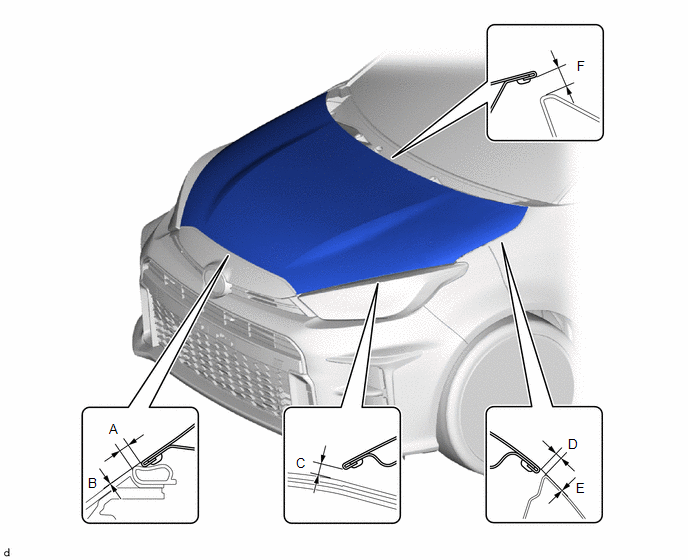 Standard Clearance
 | Area | Measurement | Area | Measurement |
|---|---|---|---|
| A | 2.0 to 6.0 mm (0.0787 to 0.236 in.) | B | -2.0 to 2.0 mm (-0.0787 to 0.0787 in.) |
| C | 3.3 to 7.3 mm (0.1299 to 0.2874 in.) | D | 2.5 to 5.5 mm (0.0984 to 0.2165 in.) |
| E | -1.5 to 1.5 mm (-0.0591 to 0.0591 in.) | F | 20.7 mm (0.8150 in.) |
 Components
C..
 Disassembly
DISASSEMBLY PROCEDURE 1. REMOVE HOOD INSULATOR (a) Remove the 4 clips.
(b) Disengage the guides to remove the hood insulator. 2. REMOVE HOOD STAY HOLDER (a) Disengage the claws to remove the hood stay holder...
Other information:
Toyota Yaris XP210 (2020-2026) Reapir and Service Manual: Gf1a Transfer Oil
ComponentsCOMPONENTS ILLUSTRATION *1 NO. 1 ENGINE UNDER COVER ASSEMBLY *2 TRANSFER FILLER PLUG *3 TRANSFER DRAIN PLUG *4 GASKET Tightening torque for "Major areas involving basic vehicle performance such as moving/turning/stopping": N*m (kgf*cm, ft...
Toyota Yaris XP210 (2020-2026) Reapir and Service Manual: Starter Signal Circuit
DESCRIPTION The engine stop and start ECU uses its internal starter circuit to drive the starter drive relay (ST No. 1 relay) and operate the starter. WIRING DIAGRAM CAUTION / NOTICE / HINT When the engine stop and start ECU is replaced, read the number of starter operations before replacement and record this number to the new engine stop and start ECU after replacement...
Categories
- Manuals Home
- Toyota Yaris Owners Manual
- Toyota Yaris Service Manual
- How to connect USB port/Auxiliary jack
- Auto Lock/Unlock Function
- Fuel Gauge
- New on site
- Most important about car
Fuel-Filler Lid and Cap
WARNING
When removing the fuel-filler cap, loosen the cap slightly and wait for any hissing to stop, then remove it
Fuel spray is dangerous. Fuel can burn skin and eyes and cause illness if ingested. Fuel spray is released when there is pressure in the fuel tank and the fuel-filler cap is removed too quickly.

Copyright © 2026 www.toyaris4.com