Toyota Yaris: Fuel and Emission / Fuel-Filler Lid and Cap
WARNING
When removing the fuel-filler cap, loosen the cap slightly and wait for any hissing to stop, then remove it
Fuel spray is dangerous. Fuel can burn skin and eyes and cause illness if ingested. Fuel spray is released when there is pressure in the fuel tank and the fuel-filler cap is removed too quickly.
Before refueling, stop the engine, and always keep sparks and flames away from the filler neck
Fuel vapor is dangerous. It could be ignited by sparks or flames causing serious burns and injuries.
Additionally, use of the incorrect fuel-filler cap or not using a fuel-filler cap may result in a fuel leak, which could result in serious burns or death in an accident.
Do not continue refueling after the fuel pump nozzle shuts off automatically
Continuing to add fuel after the fuel pump nozzle has shut off automatically is dangerous because overfilling the fuel tank may cause fuel overflow or leakage. Fuel overflow and leakage could damage the vehicle and if the fuel ignites it could cause a fire and explosion resulting in serious injury or death.
NOTICE
Always use only a genuine Toyota fuel-filler cap or an approved equivalent, available at your Toyota dealer. The wrong cap can result in a serious malfunction of the fuel and emission control systems.
It may also cause the check engine light in the combination meter to illuminate.
 Engine Exhaust (Carbon monoxide)
WARNING
Do not drive your vehicle if you smell exhaust gas inside the
vehicle
Engine exhaust gas is dangerous. This gas contains carbon monoxide
(CO), which is colorless, odorless, and poisonous...
 Refueling
Before refueling, close all the doors, windows, and the liftgate/trunk
lid, and switch the ignition OFF.
To open the fuel-filler lid, pull
the remote fuel-filler lid release...
Other information:
Toyota Yaris XP210 (2020-2026) Owner's Manual: Driving on Uneven Road
Your vehicle’s suspension and underbody can be damaged if driven on rough/uneven roads or over speed bumps at excessive speeds. Use care and reduce speed when traveling on rough/uneven roads or over speed bumps. Use care not to damage the vehicle’s underbody, bumpers or muffler(s) when driving under the following conditions: Ascending or descending a slope with a sharp transition angle Ascending or descending a driveway or trailer ramp with a sharp transition angle NOTICE This vehicle is equipped with low profile tires allowing class-leading performance and handling...
Toyota Yaris XP210 (2020-2026) Reapir and Service Manual: Components
C..
Categories
- Manuals Home
- Toyota Yaris Owners Manual
- Toyota Yaris Service Manual
- Key Battery Replacement
- Engine & Hybrid System
- Power Integration No.1 System Missing Message (B235287,B235587,B235787-B235987)
- New on site
- Most important about car
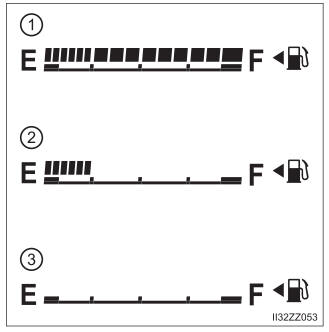
Fuel Gauge
The fuel gauge shows approximately how much fuel is remaining in the tank when the ignition is switched ON. We recommend keeping the tank over 1/4 full.