
Toyota Yaris: Headlight Assembly / Removal
REMOVAL
CAUTION / NOTICE / HINT
HINT:
- Use the same procedure for the RH side and LH side.
- The following procedure is for the LH side.
PROCEDURE
1. REMOVE FRONT BUMPER ASSEMBLY
Click here
.gif)
2. REMOVE HEADLIGHT ASSEMBLY
(a) Apply protective tape around the headlight assembly as shown in the illustration.
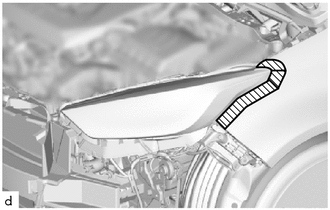
.png) | Protective Tape |
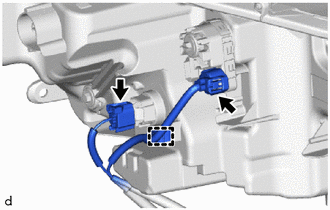
| (b) Disengage the clamp and disconnect the 2 connectors. |
|
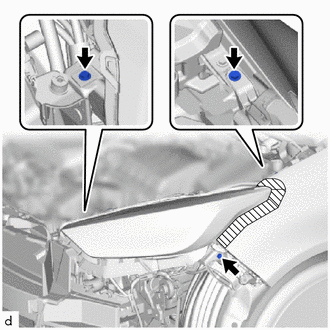
| (c) Remove the 3 screws. |
|
(d) Remove the headlight assembly as shown in the illustration.
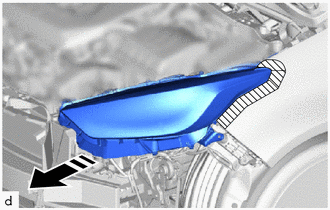
.png) | Remove in this Direction |
 Components
COMPONENTS ILLUSTRATION
*1 HEADLIGHT ASSEMBLY - - ILLUSTRATION
*1 HEADLIGHT LEVELING MOTOR *2 HEADLIGHT LEVELING MOTOR BASE PACKING *3 NO...
 Disassembly
DISASSEMBLY CAUTION / NOTICE / HINT NOTICE:
Be sure to read Precaution thoroughly before servicing.
Click here
Handle components indoors as much as possible to prevent foreign matter from entering and adhering to headlight assembly components...
Other information:
Toyota Yaris XP210 (2020-2026) Reapir and Service Manual: Components
COMPONENTS ILLUSTRATION *1 FRONT BUMPER ENERGY ABSORBER *2 FRONT BUMPER REINFORCEMENT *3 RADIATOR UPPER AIR GUIDE PLATE *4 NO. 3 AIR CLEANER INLET *5 NO. 1 AIR CLEANER INLET *6 COOL AIR INTAKE DUCT *7 NO. 1 ENGINE UNDER COVER ASSEMBLY - - N*m (kgf*cm, ft...
Toyota Yaris XP210 (2020-2026) Reapir and Service Manual: Installation
INSTALLATION CAUTION / NOTICE / HINT NOTICE: After performing the ECU configuration procedure and update ECU security key procedure, make sure to perform the initialization procedure for when the cable has been disconnected and reconnected to the negative (-) auxiliary battery terminal...
Categories
- Manuals Home
- Toyota Yaris Owners Manual
- Toyota Yaris Service Manual
- Maintenance
- Fuel Gauge
- Auto Lock/Unlock Function
- New on site
- Most important about car
Break-In Period
No special break-in is necessary, but a few precautions in the first 600 miles (1,000 km) may add to the performance, economy, and life of the vehicle.
Do not race the engine. Do not maintain one constant speed, either slow or fast, for a long period of time. Do not drive constantly at full-throttle or high engine rpm for extended periods of time. Avoid unnecessary hard stops. Avoid full-throttle starts.
Copyright © 2026 www.toyaris4.com