
Toyota Yaris: Manifold Absolute Pressure Sensor / Inspection
INSPECTION
PROCEDURE
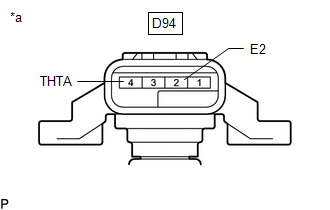
1. INSPECT NO. 2 TURBO PRESSURE SENSOR
| (a) Measure the resistance according to the value(s) in the table below. Standard Resistance:
If the result is not as specified, replace the No. 2 turbo pressure sensor. |
|
 Removal
REMOVAL PROCEDURE 1. DISCONNECT ENGINE WIRE (a) Remove the bolt.
(b) Disengage the clamp and disconnect the engine wire. 2. REMOVE NO. 1 TURBO PRESSURE SENSOR (a) Disconnect the No...
 Installation
INSTALLATION PROCEDURE 1. INSTALL NO. 2 TURBO PRESSURE SENSOR (a) Install the No. 2 turbo pressure sensor to the air tube assembly with the 2 bolts. NOTICE: If the No...
Other information:
Toyota Yaris XP210 (2020-2026) Reapir and Service Manual: Components
C..
Toyota Yaris XP210 (2020-2026) Reapir and Service Manual: Blower Motor Circuit
DESCRIPTION The blower motor with fan sub-assembly is operated by signals from the air conditioning amplifier assembly. Blower motor speed signals are transmitted in accordance with changes in the duty ratio. If the airflow volume is low or the blower speed cannot be changed, the following factors may be the cause...
Categories
- Manuals Home
- Toyota Yaris Owners Manual
- Toyota Yaris Service Manual
- Key Battery Replacement
- Fuse Panel Description
- How to connect USB port/Auxiliary jack
- New on site
- Most important about car
Fuel-Filler Lid and Cap
WARNING
When removing the fuel-filler cap, loosen the cap slightly and wait for any hissing to stop, then remove it
Fuel spray is dangerous. Fuel can burn skin and eyes and cause illness if ingested. Fuel spray is released when there is pressure in the fuel tank and the fuel-filler cap is removed too quickly.
