Toyota Yaris: Vehicle Stability Control System / Dtc Check / Clear
DTC CHECK / CLEAR
DTC CHECK
(a) Operate the GTS to read the DTCs.
Chassis > Brake > Trouble Codes(b) Check the details of the DTCs.
NOTICE:
- Make sure to clear the DTCs after repair.
- Freeze frame data is stored for each of the latest result DTCs and confirmed DTCs.
-
Refer to the diagnostic trouble code chart and perform the necessary troubleshooting procedures.
Click here

(c) Check the freeze frame data.
(1) If a DTC is stored, check the corresponding freeze frame data to gain an understanding of the vehicle condition at the time.
Click here

CHECK TIME STAMP
HINT:
By checking Time Stamp, the time and order in which DTCs were stored in an ECU can be checked.
(a) Operate the GTS to enter the Health Check.
(b) Perform the following steps when the data setting screen is displayed.
(c) Select the systems for which to perform Health Check and check for time stamp data.
- Powertrain
- Chassis
- Body
- Store All Data
(d) Select "Yes" when "Would you like to include Time Stamp Data?" is displayed.
HINT:
If "Yes" is not selected, time stamp data will not be stored.
(e) After Health Check has completed, select "Time Stamp Data" to display the Time Stamp screen.
(f) Select the desired system from the drop-down list on the bottom of the Time Stamp screen.
(g) Check the order and time which DTCs were stored for the selected system.
DTC CLEAR
(a) Operate the GTS to clear the codes.
Chassis > Brake > Clear DTCs(b) Clear the DTCs by following the prompts on the GTS.
HINT:
Refer to the GTS operator's manual for further details.
 Terminals Of Ecu
TERMINALS OF ECU TERMINALS OF ECU
*a Component without harness connected (Skid Control ECU [Brake Actuator Assembly]) - - Terminal No...
 Freeze Frame Data
FREEZE FRAME DATA FREEZE FRAME DATA (a) Using the GTS, check the vehicle condition (ECU, sensor) when the brake system operates or a DTC is output. CHECK FREEZE FRAME DATA WHEN DTC WAS STORED HINT:
Freeze frame data is stored when a DTC is output...
Other information:
Toyota Yaris XP210 (2020-2026) Reapir and Service Manual: Reassembly
REASSEMBLY PROCEDURE 1. INSTALL INPUT SHAFT FRONT BEARING INNER RACE (a) Using SST and a press, install the input shaft front bearing inner race to the input shaft. SST: 09608-00071 2. INSTALL INPUT SHAFT SNAP RING (a) Using a brass bar and hammer, tap a new input shaft snap ring to the input shaft...
Toyota Yaris XP210 (2020-2026) Owner's Manual: Auto Lock/Unlock Function
When the vehicle speed exceeds 12 mph (20 km/h), all doors and the liftgate lock automatically. When the ignition is switched off, all doors and the liftgate unlock automatically. These functions can also be disabled so that they do not operate...
Categories
- Manuals Home
- Toyota Yaris Owners Manual
- Toyota Yaris Service Manual
- To Set Speed
- Headlights
- Immobilizer System
- New on site
- Most important about car
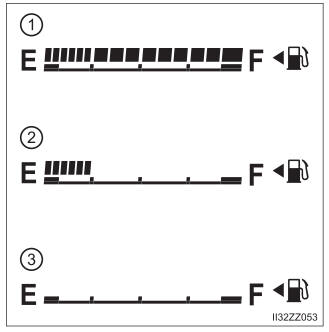
Fuel Gauge
The fuel gauge shows approximately how much fuel is remaining in the tank when the ignition is switched ON. We recommend keeping the tank over 1/4 full.