Toyota Yaris: Rear Stabilizer Bar / Removal
REMOVAL
PROCEDURE
1. REMOVE REAR WHEEL
Click here

2. REMOVE REAR STABILIZER LINK ASSEMBLY LH
| (a) Remove the cap. |
|
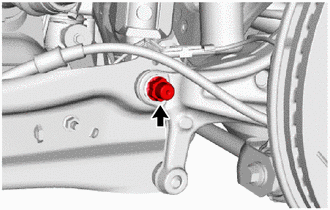
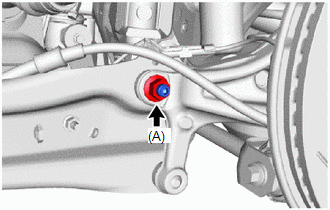
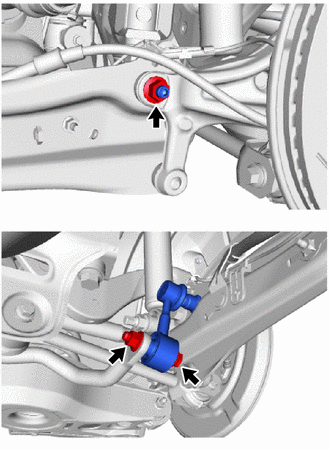
| (b) Loosen the nut (A) of the rear stabilizer link assembly LH. HINT: If the ball joint turns together with the nut, use a 6 mm hexagon socket wrench to hold the stud bolt. |
|
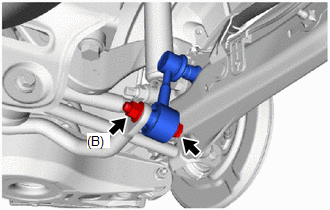
| (c) Loosen the nut (B) of the rear stabilizer link assembly LH. NOTICE: Loosen the nut with the bolt secured. |
|
| (d) Using a jack and a wooden block, support the rear No. 2 suspension arm assembly. NOTICE:
|
|
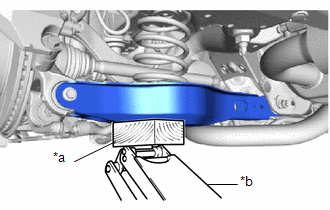
| (e) Remove the bolt, 2 nuts and rear stabilizer link assembly LH. |
|
3. REMOVE REAR STABILIZER LINK ASSEMBLY RH
HINT:
Perform the same procedure as for the LH side.
4. REMOVE REAR STABILIZER BAR
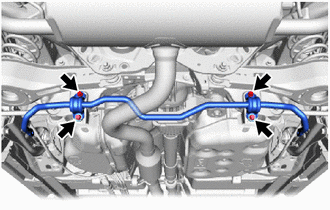
| (a) Remove the 4 bolts and rear stabilizer bar from the rear suspension member sub-assembly. |
|
 Components
COMPONENTS ILLUSTRATION
*1 REAR NO. 1 STABILIZER BAR BRACKET *2 REAR STABILIZER BAR *3 REAR STABILIZER BUSHING *4 REAR STABILIZER LINK ASSEMBLY LH *5 REAR STABILIZER LINK ASSEMBLY RH *6 CAP
Tightening torque for "Major areas involving basic vehicle performance such as moving/turning/stopping" : N*m (kgf*cm, ft...
 Inspection
INSPECTION PROCEDURE 1. INSPECT REAR STABILIZER LINK ASSEMBLY
(a) Inspect the turning torque of the ball joint. (1) Secure the rear stabilizer link assembly in a vise using aluminum plates...
Other information:
Toyota Yaris XP210 (2020-2026) Reapir and Service Manual: Differential Oil
ComponentsCOMPONENTS ILLUSTRATION *1 REAR DIFFERENTIAL FILLER PLUG *2 REAR DIFFERENTIAL DRAIN PLUG *3 GASKET - - Tightening torque for "Major areas involving basic vehicle performance such as moving/turning/stopping": N*m (kgf*cm, ft...
Toyota Yaris XP210 (2020-2026) Reapir and Service Manual: Cooling is Poor
DESCRIPTION If the cooling effect of the air conditioning system is weak, the following factors may be the cause. Symptom Factor Cooling effectiveness is poor Cooling response is slow ECO drive mode function (air flow volume is restricted due to ECO drive mode being selected) Compressor with pulley assembly malfunction Refrigerant volume (high) Refrigerant volume (low) Clogged cooler condenser assembly fins Cooling fan system malfunction Mechanical locking of damper and damper link Automatic light control sensor malfunction High inlet air temperature PROCEDURE 1...
Categories
- Manuals Home
- Toyota Yaris Owners Manual
- Toyota Yaris Service Manual
- Auto Lock/Unlock Function
- Fuse Panel Description
- How to connect USB port/Auxiliary jack
- New on site
- Most important about car
Fuel Gauge
The fuel gauge shows approximately how much fuel is remaining in the tank when the ignition is switched ON. We recommend keeping the tank over 1/4 full.