
Toyota Yaris: Fuel Injector (for Port Injection) / Removal
REMOVAL
CAUTION / NOTICE / HINT
The necessary procedures (adjustment, calibration, initialization or registration) that must be performed after parts are removed and installed, or replaced during fuel injector assembly removal/installation are shown below.
Necessary Procedures After Parts Removed/Installed/Replaced| Replaced Part or Performed Procedure | Necessary Procedure | Effect/Inoperative Function when Necessary Procedure not Performed | Link |
|---|---|---|---|
| Replacement of fuel injector assembly | Inspection after repair |
|
|

CAUTION:
-
Never perform work on fuel system components near any possible ignition sources.
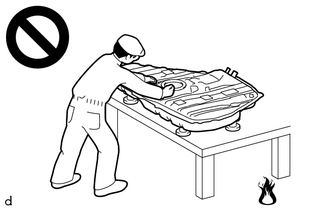
- Vaporized fuel could ignite, resulting in a serious accident.
-
Do not perform work on fuel system components without first disconnecting the cable from the negative (-) auxiliary battery terminal.
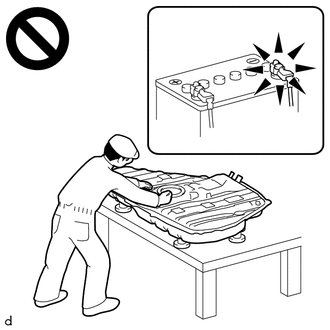
- Sparks could cause vaporized fuel to ignite, resulting in a serious accident.
NOTICE:
- After the ignition switch is turned off, the radio and display receiver assembly records various types of memory and settings. As a result, after turning the ignition switch off, make sure to wait at least 120 seconds before disconnecting the cable from the negative (-) auxiliary battery terminal.
-
This procedure includes the removal of small-head bolts. Refer to Small-Head Bolts of Basic Repair Hint to identify the small-head bolts.
Click here

HINT:
When the cable is disconnected/reconnected to the auxiliary battery terminal, systems temporarily stop operating. However, each system has a function that completes learning the first time the system is used.
-
Learning completes when vehicle is driven
Effect/Inoperative Function When Necessary Procedures are not Performed
Necessary Procedures
Link
Lane tracing assist system
Drive the vehicle straight ahead at 35 km/h (22 mph) or more for 5 second or more.

Pre-collision system
Stop and start system
Drive the vehicle until stop and start control is permitted (approximately 5 to 60 minutes)

-
Learning completes when vehicle is operated normally
Effect/Inoperative Function When Necessary Procedures are not Performed
Necessary Procedures
Link
Power door lock control system
- Back door opener
Perform door unlock operation with door control switch or electrical key transmitter sub-assembly switch.

Air conditioning system
After the ignition switch is turned to ON, the servo motor standard position is recognized.
-
PROCEDURE
1. PRECAUTION
NOTICE:
After turning the ignition switch off, waiting time may be required before disconnecting the cable from the negative (-) auxiliary battery terminal.
Click here

2. DISCHARGE FUEL SYSTEM PRESSURE
Click here

3. REMOVE NO. 1 ENGINE COVER SUB-ASSEMBLY
Click here

4. DISCONNECT ENGINE WIRE
Click here

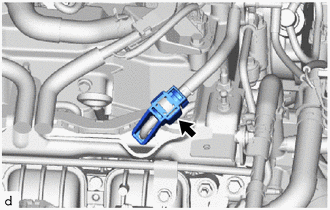
5. REMOVE FUEL PIPE CLAMP
| (a) Remove the fuel pipe clamp from the fuel tube connector. |
|
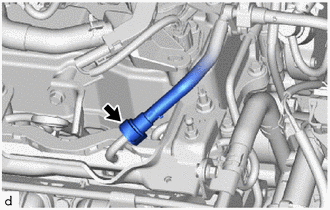
6. DISCONNECT NO. 2 FUEL TUBE SUB-ASSEMBLY
| (a) Disconnect the No. 2 fuel tube sub-assembly from the fuel delivery pipe sub-assembly. Click here
|
|

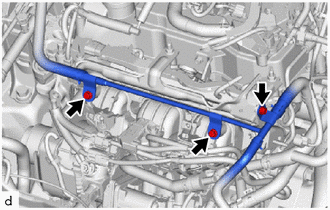
7. DISCONNECT NO. 4 WATER BY-PASS PIPE
| (a) Remove the 3 bolts and No. 4 water by-pass pipe from the cylinder head sub-assembly. |
|
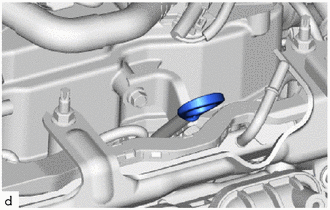
8. REMOVE OIL LEVEL GAUGE SUB-ASSEMBLY
| (a) Remove the oil level gauge sub-assembly. |
|
9. REMOVE OIL LEVEL GAUGE GUIDE
| (a) Remove the bolt and oil level gauge guide from the cylinder head sub-assembly. |
|
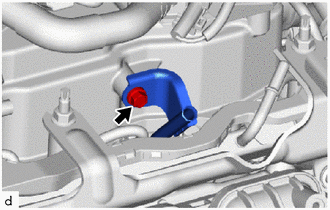
(b) Remove the O-ring from oil level gauge guide.
10. REMOVE FUEL DELIVERY GUARD
| (a) Disengage the wire harness clamp. |
|
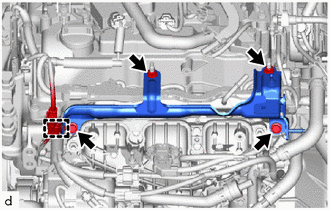
(b) Remove the 2 bolts, 2 nuts and fuel delivery guard.
11. REMOVE FUEL DELIVERY PIPE
| (a) Disconnect the connector. |
|
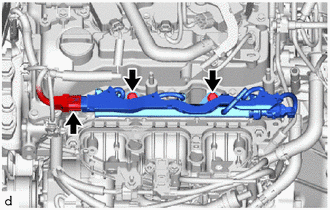
(b) Remove the 2 bolts and fuel delivery pipe with the 3 fuel injector assemblies from the cylinder head sub-assembly.
NOTICE:
Be careful not to drop the fuel injector assemblies when removing the fuel delivery pipe sub-assembly.
12. REMOVE FUEL DELIVERY SPACER
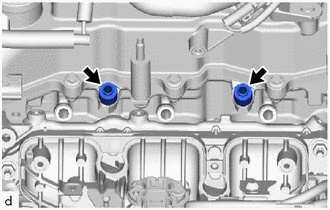
| (a) Remove the 2 fuel delivery spacers from the cylinder head sub-assembly. |
|
13. REMOVE INJECTOR VIBRATION INSULATOR
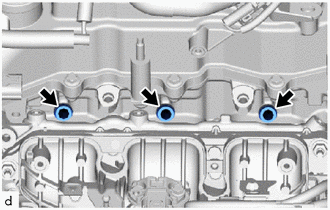
| (a) Remove the 3 injector vibration insulators from the cylinder head sub-assembly. |
|
14. REMOVE NO. 5 ENGINE WIRE
| (a) Disconnect the 4 connectors from the 3 fuel injector assemblies and fuel pressure sensor. |
|
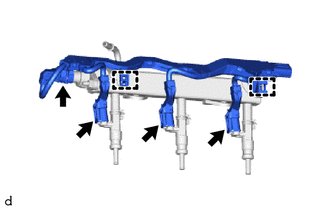
(b) Disengage the 2 clamps to remove the No. 5 engine wire from the fuel delivery pipe.
15. REMOVE PORT FUEL INJECTOR ASSEMBLY
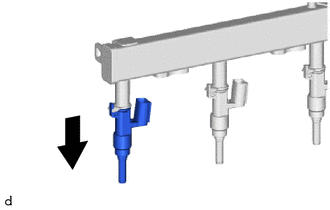
| (a) Pull the 3 fuel injector assemblies out of the fuel delivery pipe. |
|
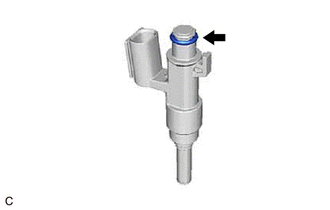
| (b) Remove the O-ring from each fuel injector assembly. |
|
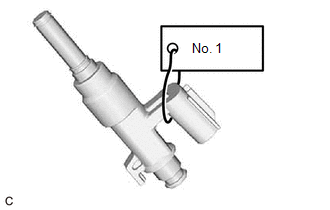
| (c) Attach a tag or label with the corresponding cylinder number to each fuel injector assembly so that they can be installed to their original locations. NOTICE: Cover the fuel injector assemblies with plastic bags to prevent damage and contamination. |
|
 Components
COMPONENTS ILLUSTRATION
*1 PORT FUEL INJECTOR ASSEMBLY *2 NO. 5 ENGINE WIRE *3 INJECTOR VIBRATION INSULATOR *4 FUEL DELIVERY SPACER *5 FUEL DELIVERY PIPE *6 FUEL DELIVERY GUARD *7 OIL LEVEL GAUGE GUIDE *8 OIL LEVEL GAUGE SUB-ASSEMBLY *9 NO...
 Inspection
INSPECTION PROCEDURE 1. INSPECT FUEL INJECTOR ASSEMBLY (a) Check the resistance. (1) Measure the resistance according to the value(s) in the table below...
Other information:
Toyota Yaris XP210 (2020-2026) Owner's Manual: Steering Wheel Adjustment
To change the angle or length of the steering wheel: Stop the vehicle, and then pull down the lock release lever under the steering column. Tilt the steering wheel and/or adjust the steering column length to the desired positions, then push the lever up to lock the column...
Toyota Yaris XP210 (2020-2026) Reapir and Service Manual: Installation
INSTALLATION CAUTION / NOTICE / HINT HINT: Use the same procedure for the RH side and LH side. The following procedure is for the LH side. PROCEDURE 1. INSTALL OUTER REAR VIEW MIRROR ASSEMBLY (a) Engage the clamp and claw to install the outer rear view mirror assembly...
Categories
- Manuals Home
- Toyota Yaris Owners Manual
- Toyota Yaris Service Manual
- Engine & Hybrid System
- How to use USB mode
- Auto Lock/Unlock Function
- New on site
- Most important about car
Liftgate/Trunk Lid
WARNING
Never allow a person to ride in the luggage compartment/trunk
Allowing a person to ride in the luggage compartment/trunk is dangerous. The person in the luggage compartment/trunk could be seriously injured or killed during sudden braking or a collision.
Do not drive with the liftgate/trunk lid open
