
Toyota Yaris: Cylinder Head Gasket / Removal
REMOVAL
CAUTION / NOTICE / HINT
The necessary procedures (adjustment, calibration, initialization, or registration) that must be performed after parts are removed and installed, or replaced during cylinder head gasket removal/installation are shown below.
Necessary Procedure After Parts Removed/Installed/Replaced| Replaced Part or Performed Procedure | Necessary Procedure | Effect/Inoperative Function when Necessary Procedure not Performed | Link |
|---|---|---|---|
| Inspection After Repair |
|
|

NOTICE:
This procedure includes the removal of small-head bolts. Refer to Small-Head Bolts of Basic Repair Hint to identify the small-head bolts.
Click here

HINT:
When the cable is disconnected / reconnected to the auxiliary battery terminal, systems temporarily stop operating. However, each system has a function that completes learning the first time the system is used.
-
Learning completes when vehicle is driven
Effect/Inoperative Function When Necessary Procedures are not Performed
Necessary Procedures
Link
Lane tracing assist system
Drive the vehicle straight ahead at 35 km/h (22 mph) or more for 5 second or more.

Pre-collision system
Stop and start system
Drive the vehicle until stop and start control is permitted (approximately 5 to 60 minutes)

-
Learning completes when vehicle is operated normally
Effect/Inoperative Function When Necessary Procedures are not Performed
Necessary Procedures
Link
Power door lock control system
- Back door opener
Perform door unlock operation with door control switch or electrical key transmitter sub-assembly switch.

Air conditioning system
After the ignition switch is turned to ON, the servo motor standard position is recognized.
-
PROCEDURE
1. REMOVE INTAKE CAMSHAFT SUB-ASSEMBLY
Click here

2. REMOVE NO. 1 CAMSHAFT BEARING CAP
Click here

3. REMOVE NO. 1 VALVE ROCKER ARM SUB-ASSEMBLY
Click here

4. REMOVE VALVE LASH ADJUSTER ASSEMBLY
Click here

5. REMOVE VALVE STEM CAP
Click here

6. REMOVE CYLINDER HEAD SUB-ASSEMBLY
Click here

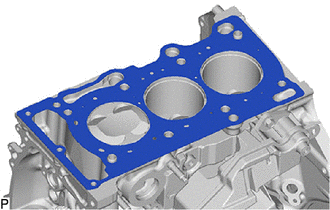
7. REMOVE CYLINDER HEAD GASKET
| (a) Remove the cylinder head gasket from the cylinder haed sub-aseembly/ |
|
8. INSPECT CYLINDER HEAD SET BOLT
Click here

9. INSPECT CYLINDER HEAD SUB-ASSEMBLY
Click here

 Components
COMPONENTS ILLUSTRATION
*1 NO. 1 VALVE ROCKER ARM SUB-ASSEMBLY *2 VALVE LASH ADJUSTER ASSEMBLY *3 VALVE STEM CAP *4 CYLINDER HEAD SUB-ASSEMBLY *5 CYLINDER HEAD GASKET *6 CYLINDER HEAD SET BOLT *7 NO...
 Installation
INSTALLATION CAUTION / NOTICE / HINT NOTICE: This procedure includes the installation of small-head bolts. Refer to Small-Head Bolts of Basic Repair Hint to identify the small-head bolts...
Other information:
Toyota Yaris XP210 (2020-2026) Reapir and Service Manual: Fuel Rail Pressure Sensor (Low) Circuit Short to Battery or Open (P107A15)
DESCRIPTION Refer to DTC P107A11. Click here DTC No. Detection Item DTC Detection Condition Trouble Area MIL Note P107A15 Fuel Rail Pressure Sensor (Low) Circuit Short to Battery or Open The No. 2 fuel pressure sensor (for low pressure side) output voltage is higher than 4...
Toyota Yaris XP210 (2020-2026) Reapir and Service Manual: Power Distribution Box System Internal Failure (B235504)
DESCRIPTION This DTC is output when the power distribution box assembly detects a Internal circuit error. DTC No. Detection Item DTC Detection Condition Trouble Area B235504 Power Distribution Box System Internal Failure Microcomputer abnormality AD circuit trouble The load drive output open or short trouble Power distribution box assembly WIRING DIAGRAM Click here CAUTION / NOTICE / HINT NOTICE: When using the GTS with the ignition switch off to troubleshoot: Connect the GTS to the vehicle, and turn a courtesy switch on and off at 1...
Categories
- Manuals Home
- Toyota Yaris Owners Manual
- Toyota Yaris Service Manual
- Engine Start Function When Key Battery is Dead
- Headlights
- Auto Lock/Unlock Function
- New on site
- Most important about car
Liftgate/Trunk Lid
WARNING
Never allow a person to ride in the luggage compartment/trunk
Allowing a person to ride in the luggage compartment/trunk is dangerous. The person in the luggage compartment/trunk could be seriously injured or killed during sudden braking or a collision.
Do not drive with the liftgate/trunk lid open
