Toyota Yaris: Air Fuel Ratio Sensor (for Sensor 1) / Removal
REMOVAL
CAUTION / NOTICE / HINT
The necessary procedures (adjustment, calibration, initialization, or registration) that must be performed after parts are removed, installed, or replaced during the air fuel ratio sensor removal/installation are shown below.
Necessary Procedure After Parts Removed/Installed/Replaced| Replacement Part or Procedure | Necessary Procedure | Effect/Inoperative when not Performed | Link |
|---|---|---|---|
| Inspection after repair |
|
|

CAUTION:
-
When the engine is hot, do not touch high-temperature areas such as the engine or exhaust manifold.
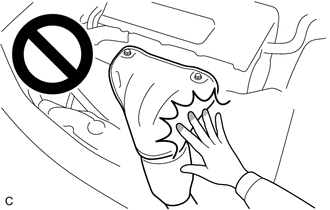
- Touching high-temperature areas such as the engine and exhaust manifold could result in burns.
PROCEDURE
1. REMOVE WINDSHIELD WIPER MOTOR AND LINK
Click here

2. REMOVE FRONT NO. 1 VENTILATOR SEAL
Click here

3. REMOVE WATER GUARD PLATE RH
Click here

4. REMOVE OUTER COWL TOP PANEL SUB-ASSEMBLY
Click here

5. SEPARATE NO. 1 AIR CLEANER HOSE
Click here

6. REMOVE INTAKE AIR RESONATOR
Click here

7. REMOVE AIR FUEL RATIO SENSOR
| (a) Disconnect the air fuel ratio sensor connector. |
|
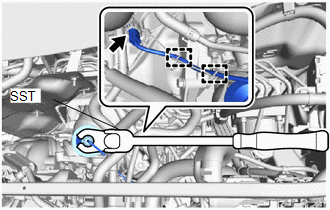
(b) Disengage the 2 clamps.
(c) Using SST, remove the air fuel ratio sensor from the exhaust manifold.
SST: 09224-00012
NOTICE:
If the air fuel ratio sensor has been struck or dropped, replace it.
 Components
COMPONENTS ILLUSTRATION
*1 WATER GUARD PLATE LH *2 NO. 1 FRONT VENTILATOR SEAL *3 OUTER COWL TOP PANEL SUB-ASSEMBLY - -
N*m (kgf*cm, ft...
 Inspection
INSPECTION PROCEDURE 1. INSPECT AIR FUEL RATIO SENSOR (a) Measure the resistance according to the value(s) in the table below. Standard Resistance: Tester Connection Condition Specified Condition D102-1(HA1A) - D102-2(+B) 20°C (68°F) 1...
Other information:
Toyota Yaris XP210 (2020-2026) Reapir and Service Manual: Fuel Receiver Gauge Malfunction
DESCRIPTION FUEL RECEIVER GAUGE OPERATION (a) OPERATION The combination meter assembly uses the fuel sender gauge assembly to detect the amount of fuel remaining in the fuel tank assembly. The Hall IC built into the fuel sender gauge assembly changes the output voltage according to the amount of fuel remaining...
Toyota Yaris XP210 (2020-2026) Reapir and Service Manual: Room Light Bulb
ReplacementREPLACEMENT PROCEDURE 1. REMOVE NO. 1 ROOM LIGHT BULB (a) Using a screwdriver with its tip wrapped in protective tape, disengage the claws to remove the No. 1 room light lens as shown in the illustration. *a Protective Tape Remove in this Direction (b) Remove the No...
Categories
- Manuals Home
- Toyota Yaris Owners Manual
- Toyota Yaris Service Manual
- Headlights
- Diagnostic Trouble Code Chart
- Battery Monitor Module General Electrical Failure (P058A01)
- New on site
- Most important about car
Keys
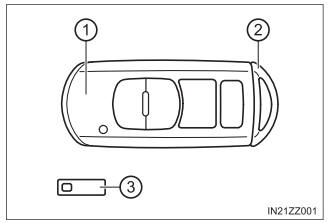
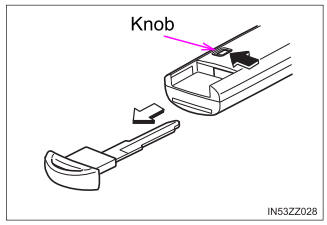
To use the auxiliary key, press the knob and pull out the auxiliary key from the smart key.