
Toyota Yaris: Charging System / Parts Location
PARTS LOCATION
ILLUSTRATION
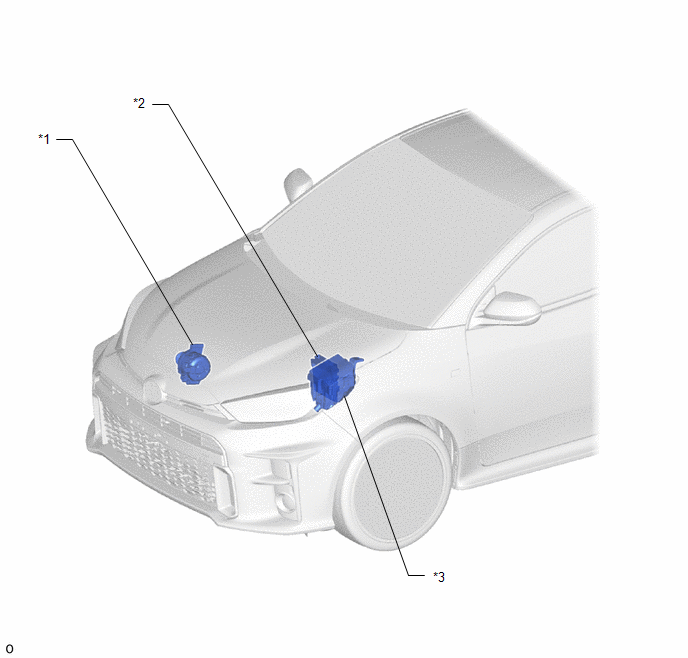
| *1 | GENERATOR ASSEMBLY | *2 | ECM |
| *3 | NO. 1 ENGINE ROOM RELAY BLOCK - EFI NO. 1 FUSE - R/B BATT FUSE - INP STD NO. 1-3 FUSE - ALT FUSE | - | - |
ILLUSTRATION
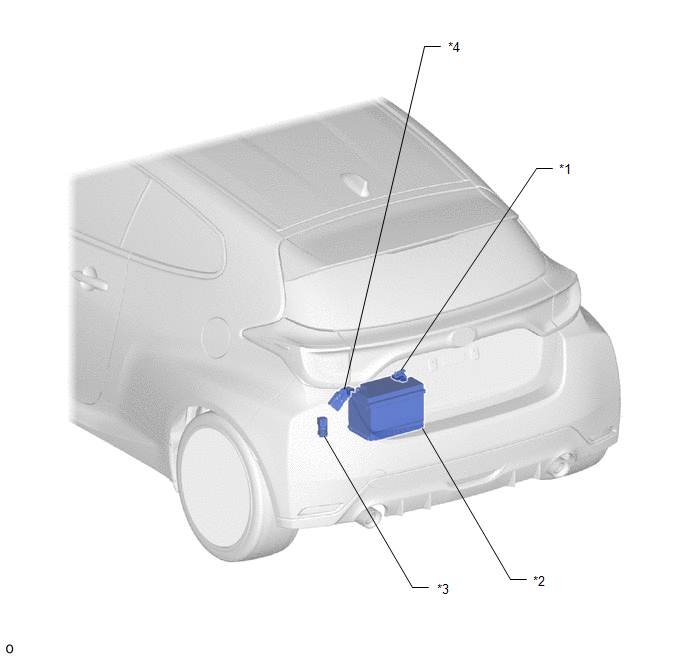
| *1 | BATTERY STATE SENSOR ASSEMBLY | *2 | AUXILIARY BATTERY |
| *3 | NO. 5 ENGINE ROOM RELAY BLOCK - BATT-S NO. 1 FUSE | *4 | FUSIBLE LINK BLOCK ASSEMBLY - R/B RR NO. 1 FUSE |
ILLUSTRATION
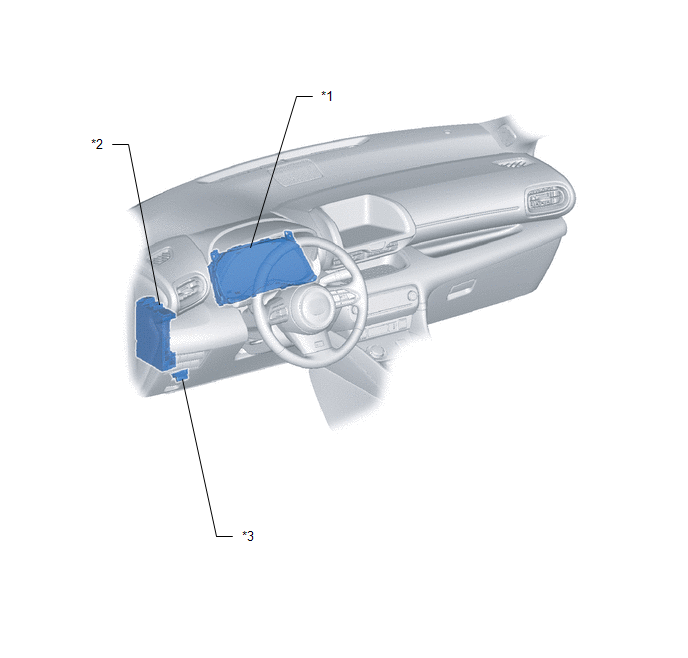
| *1 | COMBINATION METER ASSEMBLY | *2 | POWER DISTRIBUTION BOX ASSEMBLY - ECU-B NO. 2 FUSE |
| *3 | DLC3 | - | - |
 Precaution
PRECAUTION CHARGING SYSTEM PRECAUTION NOTICE:
Check that the battery cables are connected to the correct terminals.
Disconnect the battery cables when the auxiliary battery is given a quick charge...
 System Diagram
S..
Other information:
Toyota Yaris XP210 (2020-2026) Reapir and Service Manual: Installation
INSTALLATION CAUTION / NOTICE / HINT NOTICE: This procedure includes the installation of small-head bolts. Refer to Small-Head Bolts of Basic Repair Hint to identify the small-head bolts. Click here PROCEDURE 1. INSTALL REAR ENGINE OIL SEAL (a) Using height adjustment attachments and plate lift attachments, place the engine assembly on a flat level surface...
Toyota Yaris XP210 (2020-2026) Reapir and Service Manual: Components
C..
Categories
- Manuals Home
- Toyota Yaris Owners Manual
- Toyota Yaris Service Manual
- How to use USB mode
- Power Integration No.1 System Missing Message (B235287,B235587,B235787-B235987)
- Auto Lock/Unlock Function
- New on site
- Most important about car
Break-In Period
No special break-in is necessary, but a few precautions in the first 600 miles (1,000 km) may add to the performance, economy, and life of the vehicle.
Do not race the engine. Do not maintain one constant speed, either slow or fast, for a long period of time. Do not drive constantly at full-throttle or high engine rpm for extended periods of time. Avoid unnecessary hard stops. Avoid full-throttle starts.
Copyright © 2026 www.toyaris4.com