
Toyota Yaris: Driving Tips / Overloading
WARNING
Be careful not to overload your vehicle
The gross axle weight rating (GAWR) and the gross vehicle weight rating (GVWR) of the vehicle are on the Motor Vehicle Safety Standard Label on the driver’s door frame. Exceeding these ratings can cause an accident or vehicle damage. You can estimate the weight of the load by weighing the items (or people) before putting them in the vehicle.
 Driving In Flooded Area
WARNING
Dry off brakes that have become wet by driving slowly, releasing the
accelerator pedal and lightly applying the brakes several times until
the brake performance returns to normal
Driving with wet brakes is dangerous...
 Driving on Uneven Road
Your vehicle’s suspension and underbody can be damaged if
driven on rough/uneven roads or over speed bumps at excessive speeds. Use care
and reduce speed when traveling on
rough/uneven roads or over speed bumps...
Other information:
Toyota Yaris XP210 (2020-2026) Reapir and Service Manual: Precaution
PRECAUTION NOTICE: If the auxiliary battery has been discharged and charged or the cable has been disconnected and reconnected to the negative (-) auxiliary battery terminal, perform Steering Sensor Zero Point Calibration. Click here PRECAUTION FOR DISCONNECTING CABLE FROM NEGATIVE AUXILIARY BATTERY TERMINAL PRECAUTIONS FOR LANE TRACING ASSIST SYSTEM (a) Precautions for Using the Lane Tracing Assist System (1) The lane tracing assist system provides information to the driver and performs steering assistance according to the road and driving conditions...
Toyota Yaris XP210 (2020-2026) Reapir and Service Manual: HO2S Heater Control Bank 1 Sensor 1 Circuit Short to Battery (P003012,P003013,P101A9E)
DESCRIPTION The air fuel ratio sensor (sensor 1) generates current that corresponds to the actual air fuel ratio. This sensor current is used to provide the ECM with feedback so that it can control the air fuel ratio. The ECM determines the deviation from the stoichiometric air fuel ratio level, and regulates the fuel injection duration...
Categories
- Manuals Home
- Toyota Yaris Owners Manual
- Toyota Yaris Service Manual
- Engine & Hybrid System
- G16e-gts (engine Mechanical)
- Engine Start Function When Key Battery is Dead
- New on site
- Most important about car
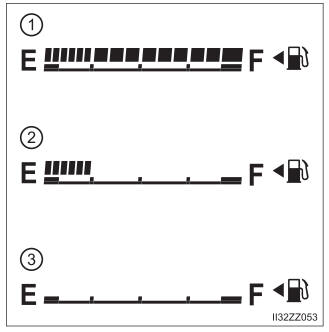
Fuel Gauge
The fuel gauge shows approximately how much fuel is remaining in the tank when the ignition is switched ON. We recommend keeping the tank over 1/4 full.

Copyright © 2026 www.toyaris4.com