
Toyota Yaris: Driving Tips / Driving on Uneven Road
Your vehicle’s suspension and underbody can be damaged if driven on rough/uneven roads or over speed bumps at excessive speeds. Use care and reduce speed when traveling on rough/uneven roads or over speed bumps.
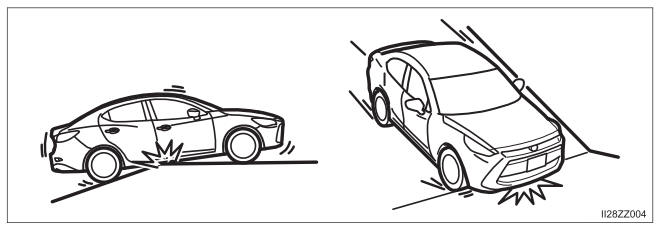
Use care not to damage the vehicle’s underbody, bumpers or muffler(s) when driving under the following conditions:
- Ascending or descending a slope with a sharp transition angle
- Ascending or descending a driveway or trailer ramp with a sharp transition angle
NOTICE
This vehicle is equipped with low profile tires allowing class-leading performance and handling. As a result, the sidewall of the tires are very thin and the tires and wheels can be damaged if driven through potholes or on rough/uneven roads at excessive speeds. Use care and reduce speed when traveling on rough/uneven roads or through potholes.
 Overloading
WARNING
Be careful not to overload your vehicle
The gross axle weight rating (GAWR) and the gross vehicle weight rating
(GVWR) of the vehicle are on the Motor Vehicle Safety Standard
Label on the driver’s door frame...
 Towing
Trailer Towing
Your Toyota is not designed for towing. Never tow a trailer with
your Toyota.
Recreational Towing
An example of “recreational towing” is towing your vehicle
behind a motorhome...
Other information:
Toyota Yaris XP210 (2020-2026) Owner's Manual: Supplemental Restraint System Components
..
Toyota Yaris XP210 (2020-2026) Reapir and Service Manual: Reassembly
REASSEMBLY CAUTION / NOTICE / HINT HINT: Use the same procedure for the RH side and LH side. The following procedure is for the LH side. PROCEDURE 1. INSTALL OUTER MIRROR RETRACTOR (a) Install a new wire harness to a new outer mirror retractor...
Categories
- Manuals Home
- Toyota Yaris Owners Manual
- Toyota Yaris Service Manual
- Auto Lock/Unlock Function
- Brake System Control Module "A" System Voltage System Voltage Low (C137BA2)
- Headlights
- New on site
- Most important about car
Break-In Period
No special break-in is necessary, but a few precautions in the first 600 miles (1,000 km) may add to the performance, economy, and life of the vehicle.
Do not race the engine. Do not maintain one constant speed, either slow or fast, for a long period of time. Do not drive constantly at full-throttle or high engine rpm for extended periods of time. Avoid unnecessary hard stops. Avoid full-throttle starts.