Toyota Yaris: Manifold Absolute Pressure Sensor / On-vehicle Inspection
ON-VEHICLE INSPECTION
PROCEDURE
1. INSPECT NO. 1 TURBO PRESSURE SENSOR
(a) Check the terminal voltage.
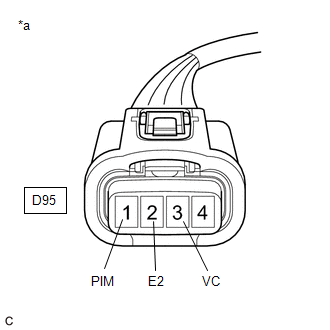
(1) Disconnect the No. 1 turbo pressure sensor connector.
(2) Turn the ignition switch to ON.
| (3) Measure the voltage according to the value(s) in the table below. Standard Voltage:
If the result is not as specified, repair or replace the wire harness or connector. |
|
(b) Check the turbo pressure.
(1) Connect the GTS to the DLC3.
(2) Turn the ignition switch to ON.
(3) Turn the GTS on.
(4) Enter the following menus: Powertrain / Engine / Data List / Boost Pressure Sensor.
Powertrain > Engine > Data List| Tester Display |
|---|
| Boost Pressure Sensor |
(5) According to the display on the GTS read the Data List.
OK:
The value is approximately equal to atmospheric pressure.
HINT:
- Standard atmospheric pressure is 101 kPa (abs) (758 mmHg (abs)).
- For every 100 m (328 ft.) increase in altitude, pressure drops by 1 kPa (7.5 mmHg). This varies with the weather.
 Components
C..
 Removal
REMOVAL PROCEDURE 1. DISCONNECT ENGINE WIRE (a) Remove the bolt.
(b) Disengage the clamp and disconnect the engine wire. 2. REMOVE NO. 1 TURBO PRESSURE SENSOR (a) Disconnect the No...
Other information:
Toyota Yaris XP210 (2020-2026) Reapir and Service Manual: Steering Angle Sensor Supply Voltage Circuit Circuit Short to Ground or Open (C14FE14)
DESCRIPTION This DTC is stored when the skid control ECU (brake actuator assembly) receives a power supply malfunction signal from the steering sensor. DTC No. Detection Item DTC Detection Condition Trouble Area DTC Output from C14FE14 Steering Angle Sensor Supply Voltage Circuit Circuit Short to Ground or Open When the +BS terminal voltage is from 9...
Toyota Yaris XP210 (2020-2026) Reapir and Service Manual: Precaution
PRECAUTION PRECAUTIONS WHEN USING GTS (a) When using the GTS with the ignition switch off, connect the GTS to the DLC3 and turn a courtesy light switch on and off at intervals of 1.5 seconds or less until communication between the GTS and the vehicle begins...
Categories
- Manuals Home
- Toyota Yaris Owners Manual
- Toyota Yaris Service Manual
- Power Integration No.1 System Missing Message (B235287,B235587,B235787-B235987)
- How to use USB mode
- Battery Monitor Module General Electrical Failure (P058A01)
- New on site
- Most important about car
Refueling
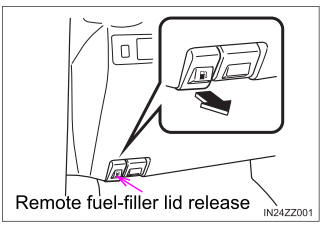
Before refueling, close all the doors, windows, and the liftgate/trunk lid, and switch the ignition OFF.
To open the fuel-filler lid, pull the remote fuel-filler lid release.