Toyota Yaris: Owner Maintenance / Engine Coolant
Inspecting Coolant Level
Inspect the antifreeze protection and coolant level in the coolant reservoir at least once a year—at the beginning of the winter season—and before traveling where temperatures may drop below freezing.
Inspect the condition and connections of all cooling system and heater hoses.
Replace any that are swollen or deteriorated.
The coolant should be at full in the radiator and between the F and L marks on the coolant reservoir when the engine is cool.
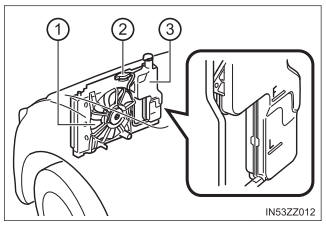
- Cooling fan
- Cooling system cap
- Coolant reservoir
If it is at or near L, add enough coolant to the coolant reservoir to pro- vide freezing and corrosion protection and to bring the level to F.
Securely tighten the coolant reservoir tank cap after adding coolant.
If the coolant reservoir is empty or new coolant is required frequently, consult your Toyota dealer.
Changing the coolant should be done by your Toyota dealer.
WARNING
Do not use a match or live flame in the engine compartment. DO NOT ADD COOLANT WHEN THE ENGINE IS HOT
A hot engine is dangerous. If the engine has been running, parts of the engine compartment can become very hot. You could be burned. Carefully inspect the engine coolant in the coolant reservoir, but do not open it.
 Pull over to a safe
location, then switch the ignition to off and
make sure the fan is not running before attempting to work near the
cooling fan
Pull over to a safe
location, then switch the ignition to off and
make sure the fan is not running before attempting to work near the
cooling fan
Working near the cooling fan when it is running is dangerous. The fan could continue running indefinitely even if the engine has stopped and the engine compartment temperature is high. You could be hit by the fan and seriously injured.
 Do not remove either
cooling system cap when the engine and
radiator are hot
Do not remove either
cooling system cap when the engine and
radiator are hot
When the engine and radiator are hot, scalding coolant and steam may shoot out under pressure and cause serious injury.
NOTICE
Radiator coolant will damage paint. Rinse it off quickly if spilled.
Use only soft (deionized) water in the coolant mixture. Water that contains minerals will cut down on the coolant’s effectiveness.
Do not add only water. Always add a proper coolant mixture.
The engine has aluminum parts and must be protected by an ethylene-glycol-based coolant to prevent corrosion and freezing.
DO NOT USE coolants Containing Alcohol, methanol, Borate or Silicate. These coolants could damage the cooling system.
DO NOT MIX alcohol or methanol with the coolant. This could damage the cooling system.
Do not use a solution that contains more than 60% antifreeze. This would reduce effectiveness.
Use of engine coolant specifically designed for the YARIS/YARIS HATCHBACK is required when replacing engine coolant. Using engine coolant that is not specifically designed for this vehicle may cause serious damage to the engine and cooling system. For questions on how to obtain this specially designed coolant, contact your Toyota dealer.
 Inspecting Engine Oil Level
Be sure the vehicle is on a level surface.
Warm up the engine to normal operating temperature.
Turn it off and wait at least 5 minutes for the oil to return to the oil
pan...
 Brake/Clutch Fluid
The brakes and clutch draw fluid from the same reservoir.
Inspect the fluid level in the reservoir regularly. It should be kept
between the MAX and MIN lines...
Other information:
Toyota Yaris XP210 (2020-2026) Reapir and Service Manual: Barometric Pressure - Turbocharger / Supercharger Boost Sensor "A" Signal Compare Failure (P00CF62)
DESCRIPTION At ignition switch to ON or during idling, the No. 2 turbo pressure sensor and the atmospheric pressure sensor built into the ECM are at atmospheric pressure and their outputs match. DTC No. Detection Item DTC Detection Condition Trouble Area MIL Note P00CF62 Barometric Pressure - Turbocharger / Supercharger Boost Sensor "A" Signal Compare Failure 15 kPa [2...
Toyota Yaris XP210 (2020-2026) Reapir and Service Manual: Removal
REMOVAL CAUTION / NOTICE / HINT The necessary procedures (adjustment, calibration, initialization or registration) that must be performed after parts are removed and installed, or replaced during fuel tank assembly removal/installation are shown below...
Categories
- Manuals Home
- Toyota Yaris Owners Manual
- Toyota Yaris Service Manual
- Power Integration No.1 System Missing Message (B235287,B235587,B235787-B235987)
- How to connect USB port/Auxiliary jack
- Key Battery Replacement
- New on site
- Most important about car
Refueling
Before refueling, close all the doors, windows, and the liftgate/trunk lid, and switch the ignition OFF.
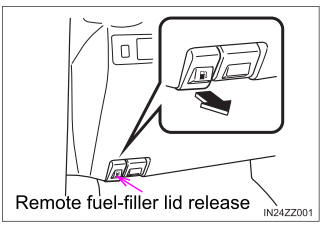
To open the fuel-filler lid, pull the remote fuel-filler lid release.