Toyota Yaris: Steering Gear / Disassembly
DISASSEMBLY
PROCEDURE
1. REMOVE STEERING RACK BOOT CLIP (for LH Side)
(a) Using pliers, remove the steering rack boot clip.
2. REMOVE STEERING RACK BOOT CLIP (for RH Side)
HINT:
Perform the same procedure as for the LH side.
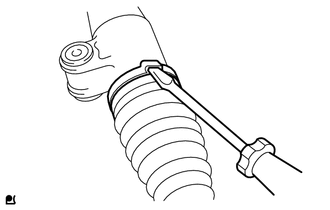
3. REMOVE NO. 2 STEERING RACK BOOT CLAMP
| (a) Using a screwdriver, remove the No. 2 steering rack boot clamp. |
|
4. REMOVE NO. 1 STEERING RACK BOOT CLAMP
HINT:
Perform the same procedure as for the No. 2 steering rack boot clamp.
5. REMOVE NO. 2 STEERING RACK BOOT
(a) Remove the No. 2 steering rack boot.
NOTICE:
- Check that there is no water, foreign matter or rust inside of the removed No. 2 steering rack boot.
- If there is no water, foreign matter or rust inside of the No. 2 steering rack boot, pull out the rack bar and check for water, foreign matter or rust.
- If water or foreign matter in either part, replace them with a new steering gear assembly.
- In order to avoid water or foreign matter from adhering to the parts, do not touch the parts unless working in a dust-free, indoors environment.
6. REMOVE NO. 1 STEERING RACK BOOT
HINT:
Perform the same procedure as for the No. 2 steering rack boot.
 Removal
REMOVAL CAUTION / NOTICE / HINT The necessary procedures (adjustment, calibration, initialization, or registration) that must be performed after parts are removed, installed, or replaced during the steering gear assembly removal/installation are shown below...
 Inspection
INSPECTION PROCEDURE 1. INSPECT TIE ROD END SUB-ASSEMBLY LH (a) Secure the tie rod end sub-assembly LH in a vise between aluminum plates. NOTICE: Do not overtighten the vise...
Other information:
Toyota Yaris XP210 (2020-2026) Reapir and Service Manual: System Description
SYSTEM DESCRIPTION LOAD OPERATION OUTPUT (a) Load is turned on or off according to the operation signals and switch signals from each ECU. Components Semiconductor Power Integration ECU Power Distribution Box Assembly Operation Signal Communication Support *1: w/ Front Seat Heater *2: Built into power distribution box assembly Headlight ECU Assembly ○ - Not supported Fog Light Assembly ○ - Supported Rear Window Defogger / Mirror Heater - ○ Supported Taillight - ○ Supported Rear Fog Light - ○ Supported Back-up Light - ○ Not supported Outer Rear View Mirror Assembly - ○ Supported Panel Illumination - ○ Supported Seat Heater LH*1 High/Low - ○ Not supported Seat Heater RH*1 High/Low - ○ Not supported Passenger Seat Buckle Switch Delegated Input - ○ - Occupant Detection Sensor Delegated Input - ○ - Rear Seat RH Buckle Switch Delegated Input - ○ - Rear Seat CTR Buckle Switch Delegated Input - ○ - Rear Seat LH Buckle Switch Delegated Input - ○ - IGR Relay*2 - ○ Not supported SEMICONDUCTOR FUSE FUNCTION (a) When a malfunction current occurs during load operation, the current is shut off before the electrical lines emit smoke, and then load is turned off...
Toyota Yaris XP210 (2020-2026) Reapir and Service Manual: Inspection
INSPECTION PROCEDURE 1. INSPECT FRONT DRIVE SHAFT ASSEMBLY (a) Check that there is no excessive play in the radial direction of the outboard joint. (b) Check that the inboard joint slides smoothly in the thrust direction. (c) Check that there is no excessive play in the radial direction of the inboard joint...
Categories
- Manuals Home
- Toyota Yaris Owners Manual
- Toyota Yaris Service Manual
- Adjustment
- Opening and Closing the Liftgate/Trunk Lid
- Engine Start Function When Key Battery is Dead
- New on site
- Most important about car
Fuel Gauge
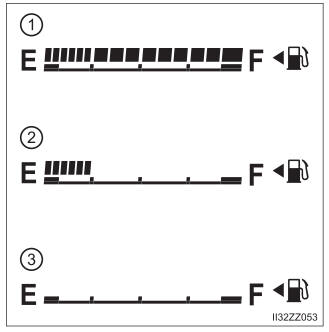
The fuel gauge shows approximately how much fuel is remaining in the tank when the ignition is switched ON. We recommend keeping the tank over 1/4 full.