
Toyota Yaris: Camshaft Oil Control Solenoid / Components
COMPONENTS
ILLUSTRATION
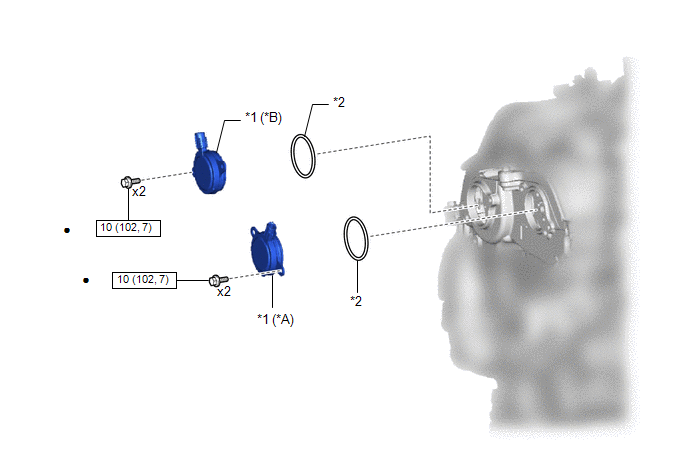
| *A | 0 for Intake Side | *B | for Exhaust Side |
| *1 | CAMSHAFT TIMING OIL CONTROL SOLENOID ASSEMBLY | *2 | O-RING |
 | N*m (kgf*cm, ft.*lbf): Specified torque | ● | Non-reusable part |
| ★ | Precoated part | - | - |

 On-vehicle Inspection
ON-VEHICLE INSPECTION PROCEDURE 1. INSPECT CAMSHAFT TIMING OIL CONTROL SOLENOID ASSEMBLY (for Intake Side) (a) Connect the GTS to the DLC3. (b) Start the engine...
Other information:
Toyota Yaris XP210 (2020-2026) Reapir and Service Manual: Removal
REMOVAL CAUTION / NOTICE / HINT The necessary procedures (adjustment, calibration, initialization, or registration) that must be performed after parts are removed and installed, or replaced during the rear No. 1 differential mount cushion replacement are shown below...
Toyota Yaris XP210 (2020-2026) Reapir and Service Manual: Terminals Of Ecu
TERMINALS OF ECU COMBINATION METER ASSEMBLY (a) Measure the voltage and resistance and check for pulses according to the value(s) in the table below. Terminal No. (Symbol) Terminal Description Condition Specified Condition H6-1 (B) - Body ground Auxiliary battery Ignition switch off 11 to 14 V H6-9 (CANH) CAN communication line - - H6-10 (MSCL) Local bus communication line - - H6-11 (TX1-) - Body ground Outside temperature sensor signal - - H6-13 (FR2) - H6-24 (FE&B) Fuel level signal Ignition switch ON, fuel level full → low (fuel level warning light on) Pulse generation (See waveform 3) H6-14 (FV) - Body ground Fuel sender gauge (Power source) Ignition switch ON Pulse generation (See waveform 1) H6-15 (MSTI) - Body ground Steering pad switch signal Ignition switch ON, up, down, right and left switches on steering pad switch not pushed 4...
Categories
- Manuals Home
- Toyota Yaris Owners Manual
- Toyota Yaris Service Manual
- To Set Speed
- Auto Lock/Unlock Function
- Immobilizer System
- New on site
- Most important about car
Front Seat Belt Pretensioners
The front seat belt pretensioners are designed to deploy in moderate or severe frontal, near frontal collisions.
In addition, the pretensioners operate when a side collision or a rollover accident is detected. The pretensioners operate differently depending on what types of air bags are equipped. For more details about the seat belt pretensioner operation, refer to the SRS Air Bag Deployment Criteria.

Copyright © 2026 www.toyaris4.com