
Toyota Yaris: Smart Key System (for Entry Function) / System Diagram
SYSTEM DIAGRAM
SMART KEY SYSTEM (for Entry Function)
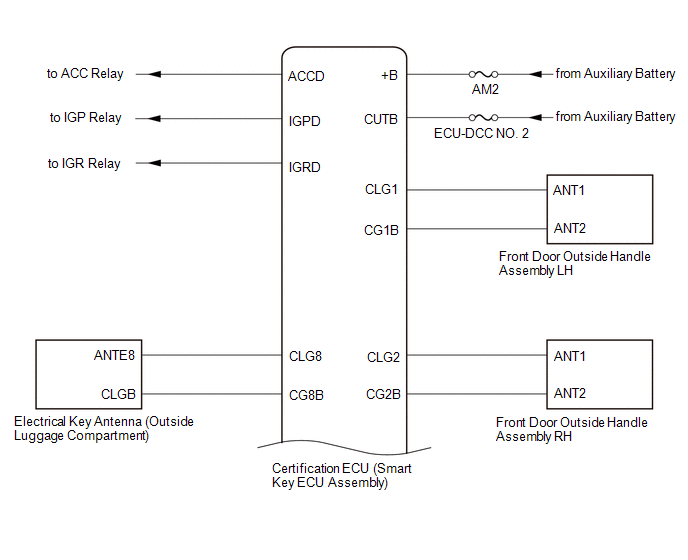
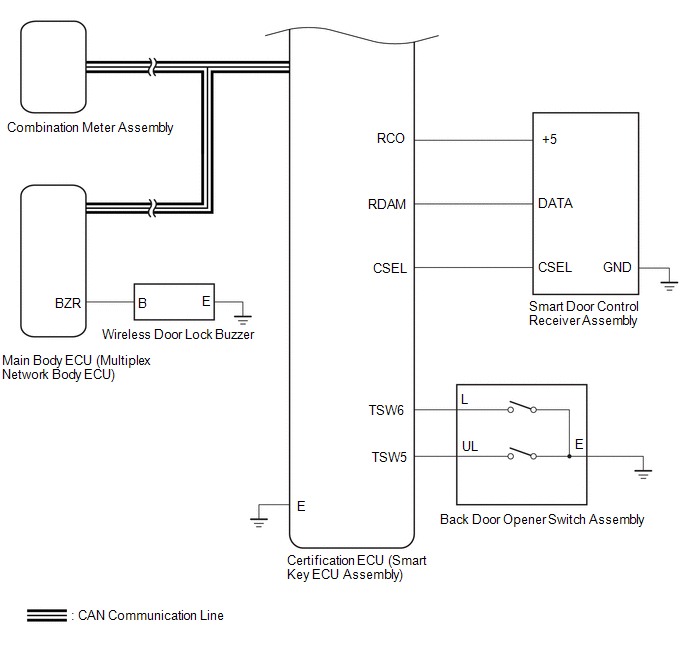
SMART KEY SYSTEM (for Start Function)
Click here

POWER DOOR LOCK CONTROL SYSTEM
Click here

WIRELESS DOOR LOCK CONTROL SYSTEM
Click here

 How To Proceed With Troubleshooting
CAUTION / NOTICE / HINT HINT:
Replace parts related to the wireless door lock and smart key system according to the inspection procedure.
If the wireless door lock and smart key system does not operate, first check the customize item and make sure that the wireless door lock and smart key system is not turned off...
 Operation Check
OPERATION CHECK CHECK CUSTOMIZE PARAMETERS NOTICE: The operation check below is based on the non-customized initial condition of the vehicle. Click here
CHECK THE ENTRY UNLOCK FUNCTION (a) Check the entry unlock function (driver door, front passenger door)...
Other information:
Toyota Yaris XP210 (2020-2026) Reapir and Service Manual: Tire And Wheel
ComponentsCOMPONENTS ILLUSTRATION *1 WHEEL ASSEMBLY *2 AXLE HUB NUT Tightening torque for "Major areas involving basic vehicle performance such as moving/turning/stopping" : N*m (kgf*cm, ft.*lbf) - - RemovalREMOVAL PROCEDURE 1...
Toyota Yaris XP210 (2020-2026) Owner's Manual: Limitations to front/near front collision detection
T..
Categories
- Manuals Home
- Toyota Yaris Owners Manual
- Toyota Yaris Service Manual
- How to use USB mode
- Maintenance
- Fuel Gauge
- New on site
- Most important about car
Fuel Gauge
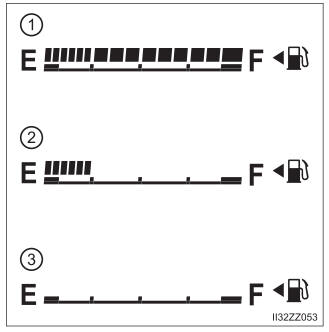
The fuel gauge shows approximately how much fuel is remaining in the tank when the ignition is switched ON. We recommend keeping the tank over 1/4 full.

Copyright © 2026 www.toyaris4.com