
Toyota Yaris: Rear Suspension / Rear Upper Arm
Components
COMPONENTS
ILLUSTRATION
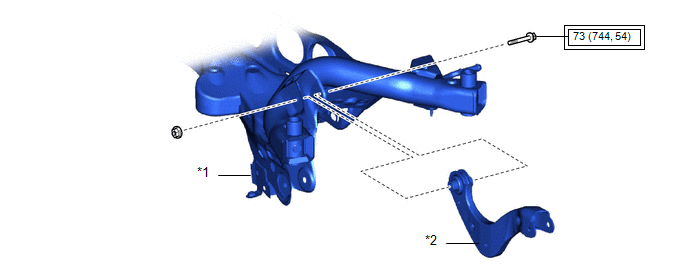
| *1 | REAR SUSPENSION MEMBER SUB-ASSEMBLY | *2 | REAR UPPER CONTROL ARM ASSEMBLY |
 | Tightening torque for "Major areas involving basic vehicle performance such as moving/turning/stopping" : N*m (kgf*cm, ft.*lbf) | - | - |
Removal
REMOVAL
CAUTION / NOTICE / HINT
The necessary procedures (adjustment, calibration, initialization, or registration) that must be performed after parts are removed and installed, or replaced during rear upper control arm assembly removal/installation are shown below.
Necessary Procedures After Parts Removed/Installed/Replaced| Replaced Part or Performed Procedure | Necessary Procedure | Effect/Inoperative Function when Necessary Procedure not Performed | Link |
|---|---|---|---|
| Rear wheel alignment adjustment | ECU Data Initialization | Active torque split AWD system |
|
| Calibration |
|
|


CAUTION:
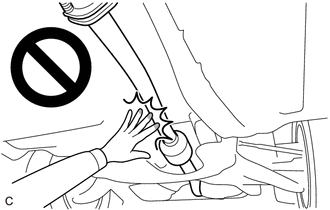
To prevent burns, do not touch the engine, exhaust pipe or other high temperature components while the engine is hot.
HINT:
- Use the same procedure for the RH side and LH side.
- The following procedure is for the LH side.
PROCEDURE
1. REMOVE REAR SUSPENSION MEMBER SUB-ASSEMBLY
Click here

2. REMOVE REAR UPPER CONTROL ARM ASSEMBLY
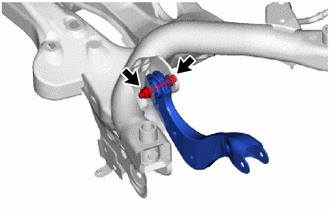
| (a) Remove the bolt, nut and rear upper control arm assembly from the rear suspension member sub-assembly. NOTICE: Loosen the bolt with the nut secured. |
|
Installation
INSTALLATION
CAUTION / NOTICE / HINT
HINT:
- Use the same procedure for the RH side and LH side.
- The following procedure is for the LH side.
PROCEDURE
1. INSTALL REAR UPPER CONTROL ARM ASSEMBLY
| (a) Temporarily install the rear upper control arm assembly to the rear suspension member sub-assembly with the bolt and nut. NOTICE:
|
|
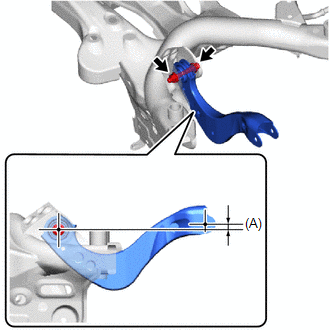
(b) Position the rear upper control arm assembly as shown in the illustration.
Reference Length (A):
5.6 mm (0.220 in.)
(c) Fully tighten the bolt.
Torque:
73 N·m {744 kgf·cm, 54 ft·lbf}
NOTICE:
Tighten the bolt with the nut secured.
2. INSTALL REAR SUSPENSION MEMBER SUB-ASSEMBLY
Click here

 Installation
INSTALLATION CAUTION / NOTICE / HINT HINT:
Use the same procedure for the RH side and LH side.
The following procedure is for the LH side.
PROCEDURE 1...
 Tire / Wheel
..
Other information:
Toyota Yaris XP210 (2020-2026) Reapir and Service Manual: Installation
INSTALLATION PROCEDURE 1. INSPECT SPIRAL CABLE WITH SENSOR SUB-ASSEMBLY (a) Check that the spiral cable with sensor sub-assembly is center position. OK: The connector is at the top. The matchmarks are aligned. The colored roller or the top of the flat cable U-turn can be checked from the check window...
Toyota Yaris XP210 (2020-2026) Reapir and Service Manual: Installation
INSTALLATION PROCEDURE 1. INSTALL BRAKE MASTER CYLINDER O-RING (a) Install a new brake master cylinder O-ring to the brake master cylinder sub-assembly. 2. INSTALL BRAKE MASTER CYLINDER SUB-ASSEMBLY NOTICE: When installing a new brake master cylinder sub-assembly, remove the protectors from the master cylinder piston and outlet ports...
Categories
- Manuals Home
- Toyota Yaris Owners Manual
- Toyota Yaris Service Manual
- G16e-gts (engine Mechanical)
- Brake System Control Module "A" System Voltage System Voltage Low (C137BA2)
- Immobilizer System
- New on site
- Most important about car
Break-In Period
No special break-in is necessary, but a few precautions in the first 600 miles (1,000 km) may add to the performance, economy, and life of the vehicle.
Do not race the engine. Do not maintain one constant speed, either slow or fast, for a long period of time. Do not drive constantly at full-throttle or high engine rpm for extended periods of time. Avoid unnecessary hard stops. Avoid full-throttle starts.