
Toyota Yaris: Spare Tire and Tool Storage / Jack
To remove the jack
4-Door
- Lift the trunk mat.
- Remove trunk board.
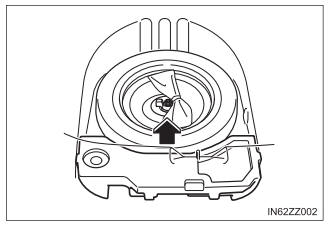
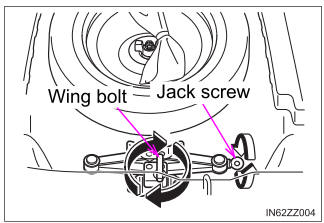
- Turn the wing bolt and jack
screw counterclockwise.
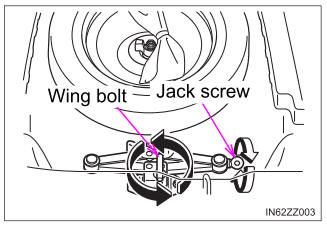
5-Door
- Remove the cover.
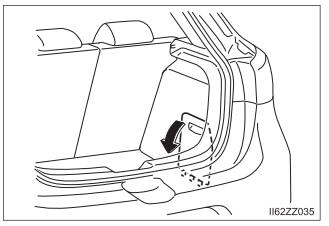
- Turn the wing bolt and jack
screw counterclockwise.
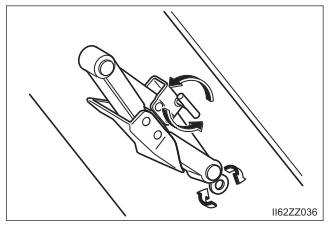
To secure the jack
- Insert the wing bolt into the jack with the jack screw pointing to the right (4-Door) or down (5-Door) and turn the wing bolt clockwise to temporarily tighten it.
- Turn the jack screw in the direction shown in the figure.
4-Door
5-Door
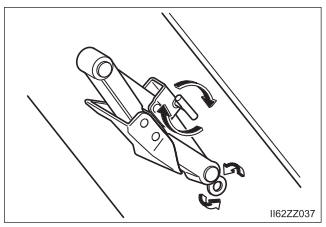
- Turn the wing bolt completely to secure the jack.
If the jack is not completely secured, it could rattle while driving. Make sure the jack screw is sufficiently tightened.
- Return the trunk board to its original position (4-Door), or insert
the cover tabs and install the cover (5-Door).
Verify that the trunk board is securely installed.
Maintenance
- Always keep the jack clean.
- Make sure the moving parts are kept free from dirt or rust.
- Make sure the screw thread is adequately lubricated.
 Spare Tire and Tool Storage
Spare tire and tools are stored in the locations illustrated in the diagram.
4-Door
Spare tire
Spare tire hold-down bolt
Tool bag
Jack
Jack point attachment* 1
Jack lever
Tiedown eyelet (if equipped)
Lug wrench
Flat tire belt* 1: The jack point attachment can be used by vehicle
repair shops and
road assistance services...
 Spare Tire
Your Toyota has a temporary spare tire. The temporary spare tire is
lighter and smaller than a conventional tire, and is designed only for
emergency use and should be used only for VERY short periods...
Other information:
Toyota Yaris XP210 (2020-2026) Reapir and Service Manual: Back Door Lock
ComponentsCOMPONENTS ILLUSTRATION *1 BACK DOOR TRIM BOARD *2 BACK DOOR LOCK ASSEMBLY W/COURTESY LIGHT SWITCH N*m (kgf*cm, ft.*lbf): Specified torque MP grease RemovalREMOVAL PROCEDURE 1. REMOVE BACK DOOR TRIM BOARD Click here 2...
Toyota Yaris XP210 (2020-2026) Reapir and Service Manual: Brake System Control Module "A" Internal Electronic Failure (C059749,...,C13C91C)
DESCRIPTION The solenoid relay and solenoid valves are built into the brake actuator assembly. The solenoid valves control the brake fluid pressure at each wheel cylinder. When this DTC is stored, the fail-safe function operates and the solenoid relay is turned off to prevent the solenoid valves from operating...
Categories
- Manuals Home
- Toyota Yaris Owners Manual
- Toyota Yaris Service Manual
- Adjustment
- Key Battery Replacement
- Immobilizer System
- New on site
- Most important about car
Liftgate/Trunk Lid
WARNING
Never allow a person to ride in the luggage compartment/trunk
Allowing a person to ride in the luggage compartment/trunk is dangerous. The person in the luggage compartment/trunk could be seriously injured or killed during sudden braking or a collision.
Do not drive with the liftgate/trunk lid open

Copyright © 2026 www.toyaris4.com