
Toyota Yaris: Brake Master Cylinder / Disassembly
DISASSEMBLY
PROCEDURE
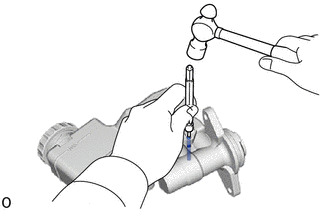
1. REMOVE BRAKE MASTER CYLINDER RING PIN
(a) Secure the brake master cylinder sub-assembly in a vise.
NOTICE:
Place aluminum plates on the vise to prevent damage to the brake master cylinder sub-assembly.
| (b) Using a 5 mm pin punch and a hammer, tap out the brake master cylinder ring pin from the brake master cylinder sub-assembly. NOTICE: Do not drop the brake master cylinder reservoir assembly. |
|
2. REMOVE BRAKE MASTER CYLINDER RESERVOIR ASSEMBLY
(a) Remove the brake master cylinder reservoir assembly from the brake master cylinder body.
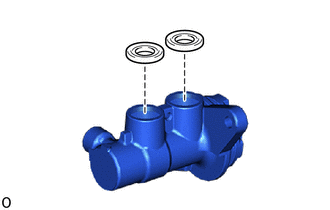
3. REMOVE MASTER CYLINDER RESERVOIR GROMMET
| (a) Remove the 2 master cylinder reservoir grommets from the brake master cylinder body. |
|
(b) Remove the brake master cylinder body from the vise.
4. REMOVE BRAKE MASTER CYLINDER RESERVOIR FILLER CAP ASSEMBLY
(a) Remove the brake master cylinder reservoir filler cap assembly from the brake master cylinder reservoir assembly.
5. REMOVE BRAKE MASTER CYLINDER RESERVOIR STRAINER
(a) Remove the brake master cylinder reservoir strainer from the brake master cylinder reservoir assembly.
 Removal
REMOVAL CAUTION / NOTICE / HINT The necessary procedures (adjustment, calibration, initialization, or registration) that must be performed after parts are removed, installed, or replaced during the brake master cylinder sub-assembly removal/installation are shown below...
 Reassembly
REASSEMBLY PROCEDURE 1. INSTALL BRAKE MASTER CYLINDER RESERVOIR STRAINER (a) Install the brake master cylinder reservoir strainer to the brake master cylinder reservoir assembly...
Other information:
Toyota Yaris XP210 (2020-2026) Reapir and Service Manual: Components
COMPONENTS ILLUSTRATION *1 SHIFT GATE PIN *2 NO. 2 LOCK BALL ASSEMBLY *3 NO. 1 LOCK BALL ASSEMBLY *4 TRANSMISSION REVOLUTION SENSOR *5 TEMPERATURE SENSOR *6 NEUTRAL POSITION SWITCH *7 BACK-UP LAMP SWITCH ASSEMBLY *8 SELECTING BELL CRANK ASSEMBLY *9 CONTROL CABLE BRACKET *10 CLUTCH RELEASE CYLINDER WITH BEARING ASSEMBLY *11 CLUTCH TUBE BOOT *12 BLEEDER CLUTCH RELEASE TUBE *13 CLUTCH RELEASE BLEEDER SUB-ASSEMBLY *14 CLUTCH RELEASE BEARING PLATE *15 RELEASE CYLINDER BLEEDER PLUG *16 RELEASE CYLINDER BLEEDER PLUG CAP *17 NO...
Toyota Yaris XP210 (2020-2026) Reapir and Service Manual: On-vehicle Inspection
ON-VEHICLE INSPECTION PROCEDURE 1. INSPECT CLUTCH PEDAL STROKE SENSOR ASSEMBLY (a) Connect the GTS to the DLC3. (b) Turn the ignition switch to ON. (c) Turn the GTS on. (d) Enter the following menus: Powertrain / Engine / Data List / Clutch Stroke Sensor Voltage...
Categories
- Manuals Home
- Toyota Yaris Owners Manual
- Toyota Yaris Service Manual
- Removal
- Headlights
- Immobilizer System
- New on site
- Most important about car
Supplemental Restraint System (SRS) Precautions
The front and side supplemental restraint systems (SRS) include different types of air bags. Please verify the different types of air bags which are equipped on your vehicle by locating the “SRS AIRBAG” location indicators. These indicators are visible in the area where the air bags are installed.
The air bags are installed in the following locations:
The steering wheel hub (driver air bag) The front passenger dashboard (front passenger air bag) The outboard sides of the front seatbacks (side air bags) The front and rear window pillars, and the roof edge along both sides (curtain air bags)