
Toyota Yaris: Condenser / Disassembly
DISASSEMBLY
PROCEDURE
1. REMOVE COOLER DRYER
| (a) Using a 14 mm straight hexagon, remove the cap from the modulator. |
|
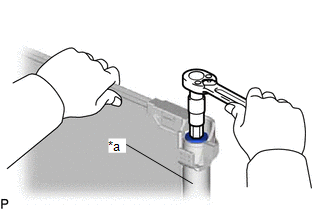
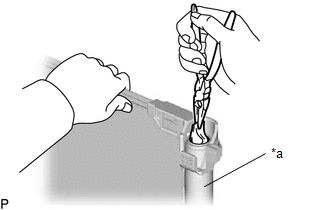
| (b) Using needle-nose pliers, remove the cooler dryer from the modulator. |
|
 Removal
REMOVAL PROCEDURE 1. RECOVER REFRIGERANT FROM REFRIGERATION SYSTEM Click here
2. REMOVE HEADLIGHT ASSEMBLY LH Click here
3. REMOVE HEADLIGHT ASSEMBLY RH HINT: Use the same procedure as for the LH side...
 Reassembly
REASSEMBLY PROCEDURE 1. INSTALL COOLER DRYER (a) Using pliers, install a new cooler dryer to the modulator.
*a Modulator (b) Sufficiently apply compressor oil to the 3 O-rings and fitting surfaces of a new cap...
Other information:
Toyota Yaris XP210 (2020-2026) Reapir and Service Manual: Customize Parameters
CUSTOMIZE PARAMETERS INSTALL CUSTOMIZE THEFT DETERRENT SYSTEM HINT: The following items can be customized. NOTICE: When the customer requests a change in a function, first make sure that the function can be customized. Be sure to make a note of the current settings before customizing...
Toyota Yaris XP210 (2020-2026) Reapir and Service Manual: Fuel Sender Circuit Open (B150013,B150113)
DESCRIPTION The fuel sender gauge assembly is connected to the combination meter assembly via direct line. If there is an open or short in the direct line, the combination meter assembly stores DTC B150013. The fuel sender gauge assembly and No. 2 fuel sender gauge assembly are connected to the combination meter assembly via direct line...
Categories
- Manuals Home
- Toyota Yaris Owners Manual
- Toyota Yaris Service Manual
- Diagnostic Trouble Code Chart
- Key Battery Replacement
- Maintenance
- New on site
- Most important about car
Break-In Period
No special break-in is necessary, but a few precautions in the first 600 miles (1,000 km) may add to the performance, economy, and life of the vehicle.
Do not race the engine. Do not maintain one constant speed, either slow or fast, for a long period of time. Do not drive constantly at full-throttle or high engine rpm for extended periods of time. Avoid unnecessary hard stops. Avoid full-throttle starts.
Copyright © 2026 www.toyaris4.com