
Toyota Yaris: Knock Sensor / Components
COMPONENTS
ILLUSTRATION
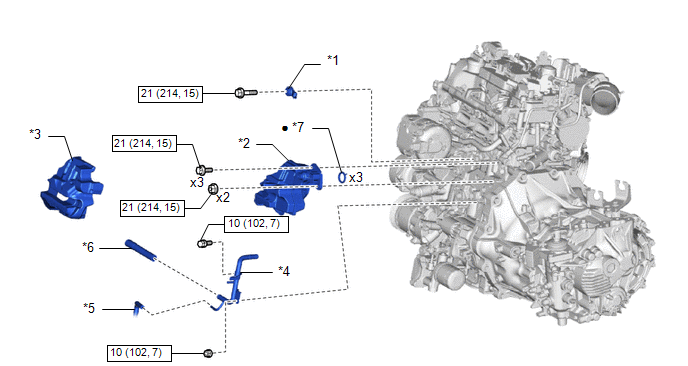
| *1 | KNOCK SENSOR | *2 | NO. 1 VENTILATION CASE |
| *3 | NO. 2 CYLINDER BLOCK INSULATOR | *4 | NO. 2 WATER BY-PASS PIPE |
| *5 | NO. 6 WATER BY-PASS HOSE | *6 | NO. 4 WATER BY-PASS HOSE |
| *7 | GASKET | - | - |
 | N*m (kgf*cm, ft.*lbf): Specified torque | ● | Non-reusable part |
 Knock Sensor
..
 Removal
REMOVAL CAUTION / NOTICE / HINT The necessary procedures (adjustment, calibration, initialization, or registration) that must be performed after parts are removed, installed, or replaced during the knock sensor removal/installation are shown below...
Other information:
Toyota Yaris XP210 (2020-2026) Reapir and Service Manual: Installation
INSTALLATION PROCEDURE 1. INSTALL AUTO HIGH BEAM SWITCH (a) Engage the claws to install the auto high beam switch as shown in the illustration. 2. INSTALL LOWER INSTRUMENT PANEL FINISH PANEL ASSEMBLY Click here 3. CONNECT HOOD LOCK CONTROL LEVER SUB-ASSEMBLY Click here 4...
Toyota Yaris XP210 (2020-2026) Reapir and Service Manual: Front Passenger Side Seat Belt Warning Light does not Operate
DESCRIPTION The combination meter assembly blinks or turns off the passenger seat belt warning light on the combination meter assembly in accordance with the state of the front seat inner belt assembly RH and occupant detection sensor (separate type front seat cushion pad RH)...
Categories
- Manuals Home
- Toyota Yaris Owners Manual
- Toyota Yaris Service Manual
- How to connect USB port/Auxiliary jack
- G16e-gts (engine Mechanical)
- Engine & Hybrid System
- New on site
- Most important about car
Break-In Period
No special break-in is necessary, but a few precautions in the first 600 miles (1,000 km) may add to the performance, economy, and life of the vehicle.
Do not race the engine. Do not maintain one constant speed, either slow or fast, for a long period of time. Do not drive constantly at full-throttle or high engine rpm for extended periods of time. Avoid unnecessary hard stops. Avoid full-throttle starts.
Copyright © 2026 www.toyaris4.com