
Toyota Yaris: Owner Maintenance / Body Lubrication
Toyota Yaris XP210 (2020-2026) Owner's Manual / Maintenance and Care / Owner Maintenance / Body Lubrication
All moving points of the body, such as door and hood hinges and locks, should be lubricated each time the engine oil is changed. Use a nonfreezing lubricant on locks during cold weather.
Make sure the hood’s secondary latch keeps the hood from opening when the primary latch is released.
 Window Washer Fluid
Inspecting Washer Fluid Level
Inspect fluid level in the washer
fluid reservoir; add fluid if necessary.
Use plain water if washer fluid is unavailable...
 Wiper Blades
Contamination of either the windshield or the blades with foreign matter
can reduce wiper effectiveness. Common sources
are insects, tree sap, and hot wax treatments used by some
commercial car washes...
Other information:
Toyota Yaris XP210 (2020-2026) Reapir and Service Manual: General Information
GENERAL INFORMATION A large number of ECU controlled systems are used in this vehicle. In general, ECU controlled systems are considered to be very intricate, requiring a high level of technical knowledge to troubleshoot. However, most problem checking procedures only involve inspecting the ECU controlled system circuits one by one...
Toyota Yaris XP210 (2020-2026) Reapir and Service Manual: Components
C..
Categories
- Manuals Home
- Toyota Yaris Owners Manual
- Toyota Yaris Service Manual
- Engine Start Function When Key Battery is Dead
- Auto Lock/Unlock Function
- Maintenance
- New on site
- Most important about car
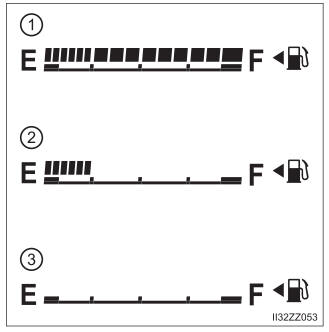
Fuel Gauge
The fuel gauge shows approximately how much fuel is remaining in the tank when the ignition is switched ON. We recommend keeping the tank over 1/4 full.

Copyright © 2026 www.toyaris4.com