
Toyota Yaris: Rain Sensor / Removal
REMOVAL
PROCEDURE
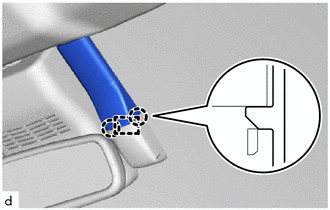
1. REMOVE RAIN SENSOR COVER
| (a) Disengage the claws and guide to remove the rain sensor cover. |
|
2. REMOVE RAIN SENSOR
(a) Release the stopper by pulling it out as shown in the illustration.
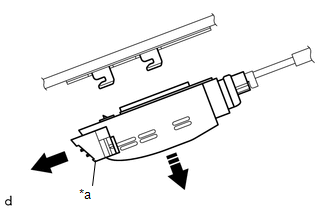
| *a | Stopper |
.png) | Release |
.png) | Separate in this Direction |
(b) Separate the rain sensor from the windshield glass as shown in the illustration.
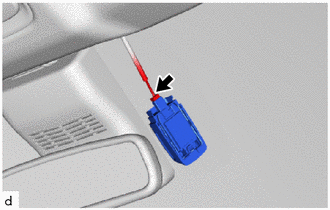
| (c) Disconnect the connecter to remove the rain sensor. NOTICE: If the rain sensor has been dropped, replace it with a new one. |
|
 On-vehicle Inspection
ON-VEHICLE INSPECTION PROCEDURE 1. INSPECT RAIN SENSOR (a) Remove the rain sensor cover. Click here
(b) Disconnect the rain sensor connector. (c) Measure the voltage according to the value(s) in the table below...
 Installation
INSTALLATION PROCEDURE 1. INSTALL RAIN SENSOR TAPE HINT:
Only perform this procedure when replacing the rain sensor tape.
Replace the rain sensor tape with new one if it is damaged or contaminated...
Other information:
Toyota Yaris XP210 (2020-2026) Reapir and Service Manual: Actuator Supply Voltage "A" Stuck On (P06579E)
MONITOR DESCRIPTION The ECM monitors the output voltage to the throttle actuator. This self-check ensures that the ECM is functioning properly. The output voltage is usually 0 V when the ignition switch is turned off. If the output voltage is 7 V or higher when the ignition switch is turned off, the ECM will illuminate the MIL and store this DTC when the ignition switch is turned to ON...
Toyota Yaris XP210 (2020-2026) Owner's Manual: Installation on rear center seat
The LATCH lower anchors at the center of the rear seat are much further apart than the sets of LATCH lower anchors for child-restraint system installation at other seating positions. Child-restraint systems with rigid LATCH attachments cannot be installed on the center seating position...
Categories
- Manuals Home
- Toyota Yaris Owners Manual
- Toyota Yaris Service Manual
- Fuse Panel Description
- How to use USB mode
- Brake System Control Module "A" System Voltage System Voltage Low (C137BA2)
- New on site
- Most important about car
Supplemental Restraint System (SRS) Precautions
The front and side supplemental restraint systems (SRS) include different types of air bags. Please verify the different types of air bags which are equipped on your vehicle by locating the “SRS AIRBAG” location indicators. These indicators are visible in the area where the air bags are installed.
The air bags are installed in the following locations:
The steering wheel hub (driver air bag) The front passenger dashboard (front passenger air bag) The outboard sides of the front seatbacks (side air bags) The front and rear window pillars, and the roof edge along both sides (curtain air bags)