
Toyota Yaris: Input Shaft / Inspection
INSPECTION
PROCEDURE
1. INSPECT INPUT SHAFT
| (a) Check the input shaft for wear and damage. |
|
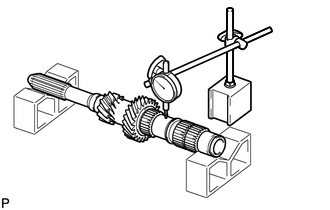
(b) Using a dial indicator, measure the input shaft runout.
Maximum Runout:
0.01 mm (0.000394 in.)
(1) If the runout exceeds the maximum, replace the input shaft.
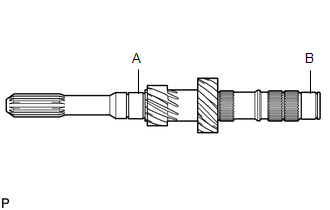
| (c) Using a micrometer, measure the outer diameter of the input shaft journal surface. Standard:
(1) If the outer diameter is below the minimum, replace the input shaft. |
|
 Disassembly
DISASSEMBLY PROCEDURE 1. REMOVE INPUT SHAFT REAR BEARING SHAFT SNAP RING (a) Using a snap ring expander, remove the input shaft rear bearing shaft snap ring from the input shaft...
 Reassembly
REASSEMBLY PROCEDURE 1. INSTALL INPUT SHAFT FRONT BEARING INNER RACE (a) Using SST and a press, install the input shaft front bearing inner race to the input shaft...
Other information:
Toyota Yaris XP210 (2020-2026) Reapir and Service Manual: Analog to Digital Converter Circuit Voltage Out of Range (P060B1C,P060B49,P060B71)
DESCRIPTION If an internal malfunction occurs in the engine stop and start ECU, it stores P060B1C, P060B49 or P060B71 and blinks the stop and start cancel indicator. DTC No. Detection Item DTC Detection Condition Trouble Area Warning Indicate Memory Note P060B1C Analog to Digital Converter Circuit Voltage Out of Range Both of the following conditions are met for 0...
Toyota Yaris XP210 (2020-2026) Owner's Manual: Cleaning the Window Interiors
If the windows become covered with an oily, greasy, or waxy film, clean them with glass cleaner. Follow the directions on the container. NOTICE Do not scrape or scratch the inside of the window glass. It could damage the thermal filaments and the antenna lines...
Categories
- Manuals Home
- Toyota Yaris Owners Manual
- Toyota Yaris Service Manual
- How to use USB mode
- Key Battery Replacement
- Brake System Control Module "A" System Voltage System Voltage Low (C137BA2)
- New on site
- Most important about car
Liftgate/Trunk Lid
WARNING
Never allow a person to ride in the luggage compartment/trunk
Allowing a person to ride in the luggage compartment/trunk is dangerous. The person in the luggage compartment/trunk could be seriously injured or killed during sudden braking or a collision.
Do not drive with the liftgate/trunk lid open
