
Toyota Yaris: Heated Steering Wheel System / How To Proceed With Troubleshooting
Toyota Yaris XP210 (2020-2026) Reapir and Service Manual / Steering / Steering Column / Heated Steering Wheel System / How To Proceed With Troubleshooting
CAUTION / NOTICE / HINT
HINT:
Use these procedures to troubleshoot the heated steering wheel system.
PROCEDURE
| 1. | VEHICLE BROUGHT TO WORKSHOP |
|

| 2. | INSPECT AUXILIARY BATTERY |
(a) Measure the auxiliary battery voltage with the ignition switch off.
Standard voltage:
11 to 14 V (Ignition switch off)
If the voltage is below 11 V, replace or recharge the auxiliary battery before proceeding to the next step.
|

| 3. | PROBLEM SYMPTOMS TABLE |
HINT:
Refer to Problem Symptoms Table.
Click here

|

| 4. | REPAIR OR REPLACE |
|

| 5. | CONFIRMATION TEST |
| NEXT |
 | END |
 System Description
SYSTEM DESCRIPTION HEATED STEERING WHEEL SYSTEM (a) The steering heater warms up the steering wheel when the steering heater switch is turned on. (b) The steering heater uses a control thermostat inside the steering wheel to maintain the steering wheel at the specified temperature...
 Problem Symptoms Table
PROBLEM SYMPTOMS TABLE HINT: Use the table below to help determine the cause of problem symptoms. If multiple suspected areas are listed, the potential causes of the symptoms are listed in order of probability in the "Suspected Area" column of the table...
Other information:
Toyota Yaris XP210 (2020-2026) Reapir and Service Manual: Front Door Right Speaker Circuit Actuator Stuck (B1AAF71)
DESCRIPTION This DTC is output when a malfunction occurs in the right side front speaker system. DTC No. Detection Item DTC Detection Condition Trouble Area B1AAF71 Front Door Right Speaker Circuit Actuator Stuck When starting the system from IG OFF → ACC ON, the stereo component equalizer assembly detects a malfunction in the right side front speaker system* Harness or connector Front No...
Toyota Yaris XP210 (2020-2026) Reapir and Service Manual: System Description
SYSTEM DESCRIPTION OUTLINE OF THEFT DETERRENT SYSTEM The theft deterrent system can be set by locking the doors using any of the following operations: Entry lock operation Wireless lock operation Key linked lock operation By opening and closing the doors In the armed state, the alarm function will be activated if one of the following conditions is met: Any of the doors are unlocked...
Categories
- Manuals Home
- Toyota Yaris Owners Manual
- Toyota Yaris Service Manual
- Engine Start Function When Key Battery is Dead
- Removal
- Battery Monitor Module General Electrical Failure (P058A01)
- New on site
- Most important about car
Refueling
Before refueling, close all the doors, windows, and the liftgate/trunk lid, and switch the ignition OFF.
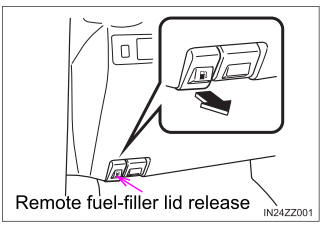
To open the fuel-filler lid, pull the remote fuel-filler lid release.

Copyright © 2026 www.toyaris4.com