
Toyota Yaris: Fuel Injector (for Direct Injection) / Components
COMPONENTS
ILLUSTRATION
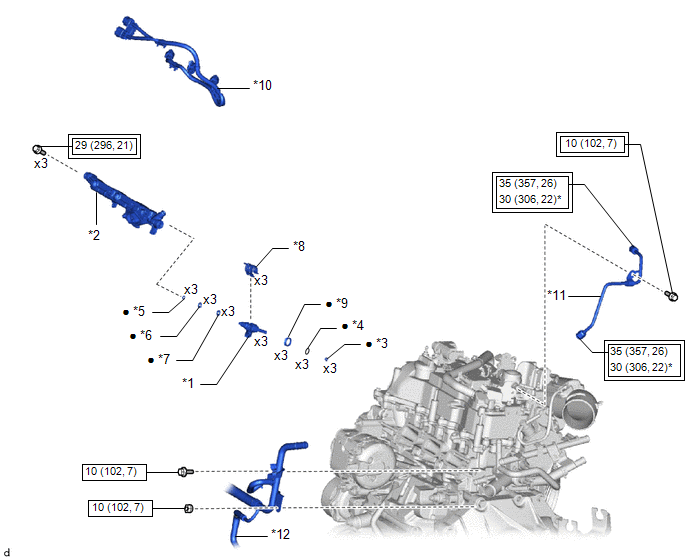
| *1 | FUEL INJECTOR ASSEMBLY | *2 | FUEL DELIVERY PIPE |
| *3 | FUEL INJECTOR SEAL | *4 | C-RING |
| *5 | NO. 3 FUEL INJECTOR BACK-UP RING | *6 | O-RING |
| *7 | NO. 1 FUEL INJECTOR BACK-UP RING | *8 | NOZZLE HOLDER CLAMP |
| *9 | INJECTOR VIBRATION INSULATOR | *10 | NO. 6 ENGINE WIRE |
| *11 | NO. 1 FUEL PIPE SUB-ASSEMBLY | *12 | NO. 2 WATER BY-PASS PIPE |
 | Tightening torque for "Major areas involving basic vehicle performance such as moving/turning/stopping": N*m (kgf*cm, ft.*lbf) |
 | N*m (kgf*cm, ft.*lbf): Specified torque |
| * | For use with SST | ● | Non-reusable part |

 Removal
REMOVAL CAUTION / NOTICE / HINT The necessary procedures (adjustment, calibration, initialization or registration) that must be performed after parts are removed and installed, or replaced during fuel injector assembly removal/installation are shown below...
Other information:
Toyota Yaris XP210 (2020-2026) Reapir and Service Manual: Entire Combination Meter does not Operate
DESCRIPTION This circuit is the power source circuit for the combination meter assembly. This circuit provides two types of power sources; one is a constant power source, and the other is an IG power source. WIRING DIAGRAM CAUTION / NOTICE / HINT NOTICE: When replacing the combination meter assembly, always replace it with a new one...
Toyota Yaris XP210 (2020-2026) Reapir and Service Manual: Problem Symptoms Table
PROBLEM SYMPTOMS TABLE HINT: Use the table below to help determine the cause of problem symptoms. If multiple suspected areas are listed, the potential causes of the symptoms are listed in order of probability in the "Suspected Area" column of the table...
Categories
- Manuals Home
- Toyota Yaris Owners Manual
- Toyota Yaris Service Manual
- How to connect USB port/Auxiliary jack
- To Set Speed
- Brake System Control Module "A" System Voltage System Voltage Low (C137BA2)
- New on site
- Most important about car
Fuel Gauge
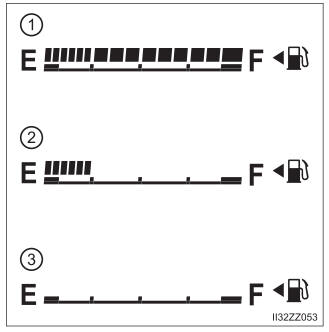
The fuel gauge shows approximately how much fuel is remaining in the tank when the ignition is switched ON. We recommend keeping the tank over 1/4 full.

Copyright © 2026 www.toyaris4.com