
Toyota Yaris: Tiedown Hooks (If equipped) / Tiedown Hook-Front
Toyota Yaris XP210 (2020-2026) Owner's Manual / If Trouble Arises / Emergency Towing / Tiedown Hooks (If equipped) / Tiedown Hook-Front
- Remove the tiedown eyelet and the lug wrench from the luggage compartment.
- Wrap a jack lever or similar tool
with a soft cloth to prevent damage to a painted bumper, and
open the cap located on the
front bumper.
Remove the cap completely and store it so as not to lose it.
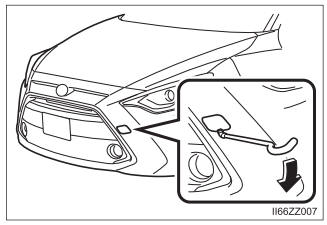
- Securely install the tiedown eyelet using the lug
wrench.
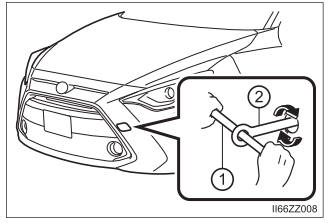
- Lug wrench
- Tiedown eyelet
- Hook the tying rope to the tiedown eyelet.
NOTICE
- Do not use excessive force as it may damage the cap or scratch the painted bumper surface.
- If the tiedown eyelet is not securely tightened, it may loosen or disengage from the bumper when tying the vehicle. Make sure that the tiedown eyelet is securely tightened to the bumper.
 Tiedown Hooks (If equipped)
NOTICE
Do not use the front tiedown eyelet for towing the vehicle.
They have been designed only for securing the vehicle to a transport
vessel
during shipping...
 Tiedown Hook-Rear
The hook positioned under the
rear bumper on the right side is for
tying down the vehicle during
transport, and it cannot be used
for towing other vehicles...
Other information:
Toyota Yaris XP210 (2020-2026) Reapir and Service Manual: Installation
INSTALLATION CAUTION / NOTICE / HINT NOTICE: After performing the update ECU security key procedure, make sure to perform the initialization procedure for when the cable has been disconnected and reconnected to the negative (-) auxiliary battery terminal...
Toyota Yaris XP210 (2020-2026) Reapir and Service Manual: Components
C..
Categories
- Manuals Home
- Toyota Yaris Owners Manual
- Toyota Yaris Service Manual
- Auto Lock/Unlock Function
- Battery Monitor Module General Electrical Failure (P058A01)
- Adjustment
- New on site
- Most important about car
Fuel Gauge
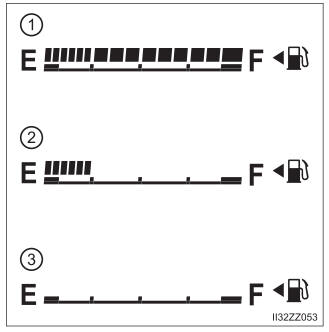
The fuel gauge shows approximately how much fuel is remaining in the tank when the ignition is switched ON. We recommend keeping the tank over 1/4 full.

Copyright © 2026 www.toyaris4.com