Toyota Yaris: Stop And Start System / Diagnosis System
DIAGNOSIS SYSTEM
DESCRIPTION
When troubleshooting a vehicle with a diagnosis system, the only difference from the usual troubleshooting procedure is connecting the GTS to the vehicle and reading various data output from the engine stop and start ECU.
The engine stop and start ECU records DTCs when it detects a malfunction in itself or in its circuits.
To check for DTCs, connect the GTS to the DLC3 on the vehicle. The GTS can be used to clear the DTCs, activate various actuators, and check the Freeze Frame Data and Data List.
AUXILIARY BATTERY VOLTAGE
Standard Voltage:
11 to 14 V
If voltage is below 11 V, recharge or replace the auxiliary battery.
CHECK DLC3 (Data Link Connector 3)
(a) Check the DLC3.
Click here

FREEZE FRAME DATA
The ECU records vehicle and driving condition information as freeze frame data the moment a DTC is stored. When troubleshooting, freeze frame data can be helpful in determining whether the vehicle was moving or stationary, whether the engine was warmed up or not, as well as other data recorded at the time of a malfunction.
 Terminals Of Ecu
TERMINALS OF ECU ENGINE STOP AND START ECU
(a) Disconnect the engine stop and start ECU connectors. (b) Measure the resistance and voltage according to the value(s) in the table below...
 Dtc Check / Clear
DTC CHECK / CLEAR HINT:
DTCs, which are stored in the engine stop and start ECU, can be displayed on the GTS. The GTS can display confirmed and pending DTCs...
Other information:
Toyota Yaris XP210 (2020-2026) Reapir and Service Manual: Data List / Active Test
DATA LIST / ACTIVE TEST DATA LIST NOTICE: In the following table, the values listed under "Normal Condition" are reference values. Do not depend solely on these reference values when deciding whether a part is faulty or not. HINT: Using the GTS to read the Data List allows the values or states of switches, sensors, actuators and other items to be read without removing any parts...
Toyota Yaris XP210 (2020-2026) Reapir and Service Manual: Problem Symptoms Table
PROBLEM SYMPTOMS TABLE HINT: Use the table below to help determine the cause of problem symptoms. If multiple suspected areas are listed, the potential causes of the symptoms are listed in order of probability in the "Suspected Area" column of the table...
Categories
- Manuals Home
- Toyota Yaris Owners Manual
- Toyota Yaris Service Manual
- To Set Speed
- Power Integration No.1 System Missing Message (B235287,B235587,B235787-B235987)
- Battery Monitor Module General Electrical Failure (P058A01)
- New on site
- Most important about car
Keys
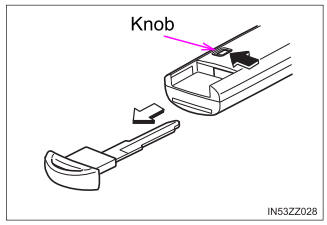
To use the auxiliary key, press the knob and pull out the auxiliary key from the smart key.