
Toyota Yaris: Fuel Pressure Sensor / Components
COMPONENTS
ILLUSTRATION
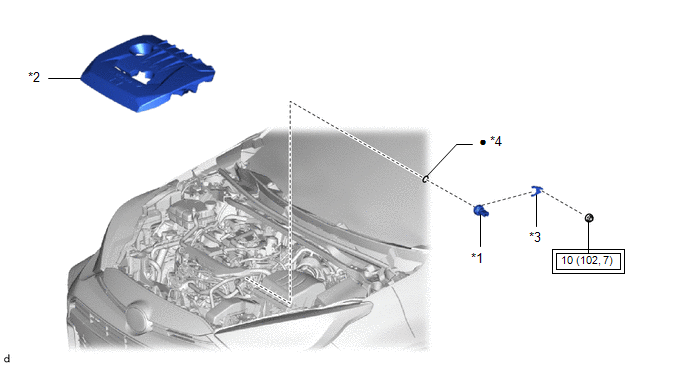
| *1 | NO. 2 FUEL PRESSURE SENSOR | *2 | NO. 1 ENGINE COVER SUB-ASSEMBLY |
| *3 | NO. 2 FUEL PRESSURE SENSOR HOLDER | *4 | O-RING |
 | Tightening torque for "Major areas involving basic vehicle performance such as moving/turning/stopping": N*m (kgf*cm, ft.*lbf) | ● | Non-reusable part |

 Removal
REMOVAL CAUTION / NOTICE / HINT The necessary procedures (adjustment, calibration, initialization or registration) that must be performed after parts are removed and installed, or replaced during No...
Other information:
Toyota Yaris XP210 (2020-2026) Owner's Manual: Essential Information Introduction
Be careful not to hurt yourself when inspecting your vehicle, replacing a tire, or doing some kind of maintenance such as car washing. In particular, wear thick work gloves such as cotton gloves when touching areas that are difficult to see while inspecting or working on your vehicle...
Toyota Yaris XP210 (2020-2026) Reapir and Service Manual: Front Wiper Motor
ComponentsCOMPONENTS ILLUSTRATION *1 WINDSHIELD WIPER MOTOR AND LINK *2 COWL TOP VENTILATOR LOUVER SUB-ASSEMBLY *3 FRONT WIPER ARM HEAD CAP *4 FRONT WIPER ARM AND BLADE ASSEMBLY LH *5 FRONT WIPER ARM AND BLADE ASSEMBLY RH *6 FRONT FENDER TO COWL SIDE SEAL RH *7 FRONT FENDER TO COWL SIDE SEAL LH - - N*m (kgf*cm, ft...
Categories
- Manuals Home
- Toyota Yaris Owners Manual
- Toyota Yaris Service Manual
- How to connect USB port/Auxiliary jack
- Removal
- Diagnostic Trouble Code Chart
- New on site
- Most important about car
Front Seat Belt Pretensioners
The front seat belt pretensioners are designed to deploy in moderate or severe frontal, near frontal collisions.
In addition, the pretensioners operate when a side collision or a rollover accident is detected. The pretensioners operate differently depending on what types of air bags are equipped. For more details about the seat belt pretensioner operation, refer to the SRS Air Bag Deployment Criteria.

Copyright © 2026 www.toyaris4.com