Toyota Yaris: Tires / Tire Inflation Pressure
Inspect all tire pressures monthly (including the spare) when the tires are cold. Maintain recommended pressures for the best ride, handling, and minimum tire wear.
Refer to the specification charts.
With tire pressure monitoring system: After adjusting the tire pressure, initialization of the tire pressure monitoring system is necessary to make the system operate normally. Refer to Tire Pressure Monitoring System Initialization.
- Always check tire pressure when tires are cold.
- Warm tires normally exceed recommended pressures. Do not release air from warm tires to adjust the pressure.
- Underinflation can cause reduced fuel economy, uneven and accelerated tire wear, and poor sealing of the tire bead, which will deform the wheel and cause separation of tire from rim.
- Overinflation can produce a harsh ride, uneven and accelerated tire
wear, and a greater possibility of damage from road hazards.
Keep your tire pressure at the correct levels. If one frequently needs inflating, have it inspected.
WARNING
Always inflate the tires to the correct pressure
Overinflation or underinflation of tires is dangerous. Adverse handling or unexpected tire failure could result in a serious accident.
Use only a Toyota-genuine tire valve cap
Use of a non-genuine part is dangerous as the correct tire air pressure cannot be maintained if the tire valve becomes damaged. If the vehicle is driven under this condition, the tire air pressure will decrease which could result in a serious accident. Do not use any part for the tire valve cap that is not a Toyota-genuine part.
 Tires
Tires
For reasons of proper performance, safety, and better fuel economy, always
maintain recommended tire inflation pressures and stay within the recommended
load limits and weight distribution...
 Tire Rotation
During rotation, inspect them for
correct balance.
Also, inspect them for uneven wear and damage. Abnormal wear is
usually caused by one or a combination of the following:
Incorrect tire pressure
Improper wheel alignment
Out-of-balance wheel
Severe braking
After rotation, inflate all tire pressures to specification and
inspect the lug nuts for tightness...
Other information:
Toyota Yaris XP210 (2020-2026) Reapir and Service Manual: Problem Symptoms Table
PROBLEM SYMPTOMS TABLE If there are no DTCs output and the problem still occurs, check the suspected areas for each problem symptom in the order given in the following table and proceed to the relevant troubleshooting page. NOTICE: When replacing the skid control ECU (brake actuator assembly), sensors, etc...
Toyota Yaris XP210 (2020-2026) Owner's Manual: Side Air Bags
The side air bags are mounted in the outboard sides of the front seatbacks. When the air bag crash sensors detect a side impact of greater than moderate force, the system inflates the side air bag only on the side in which the vehicle was hit...
Categories
- Manuals Home
- Toyota Yaris Owners Manual
- Toyota Yaris Service Manual
- How to use USB mode
- Removal
- Key Battery Replacement
- New on site
- Most important about car
Refueling
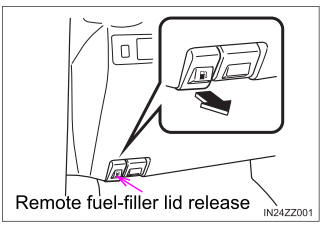
Before refueling, close all the doors, windows, and the liftgate/trunk lid, and switch the ignition OFF.
To open the fuel-filler lid, pull the remote fuel-filler lid release.