
Toyota Yaris: Manual Transaxle Operation / Recommendations for Shifting
Toyota Yaris XP210 (2020-2026) Owner's Manual / When Driving / Transaxle / Manual Transaxle Operation / Recommendations for Shifting
Upshifting
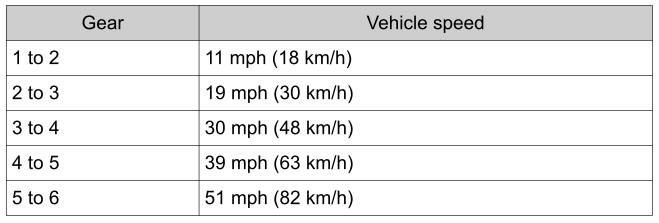
For normal acceleration, Toyota recommends these shift points:
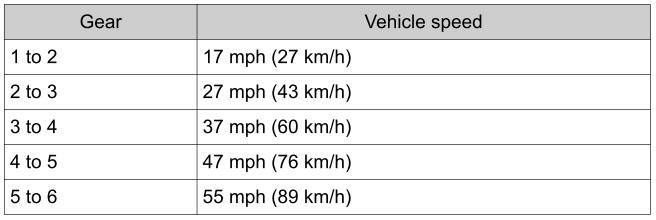
For cruising, Toyota recommends these shift points:
Downshifting
When you must slow down in heavy traffic or on a steep upgrade, downshift before the engine starts to overwork. This reduces the chance of stalling and gives better acceleration when you need more speed.
On a steep downgrade, downshifting helps maintain safe speed and prolongs brake life.
 Gear Shift Indicator
The gear shift indicator supports you to obtain optimum fuel economy
and smooth driving. It displays the selected gear position in the combination
meter as well as notifies the driver to change to the most suitable gear
position corresponding to the actual driving condition...
 Automatic Transaxle Controls
Various Lockouts:
Indicates that you must depress the brake pedal and hold in
the lock-release button to shift (The ignition must be
switched ON)...
Other information:
Toyota Yaris XP210 (2020-2026) Reapir and Service Manual: On-vehicle Inspection
ON-VEHICLE INSPECTION PROCEDURE 1. INSPECT COOLER CONDENSER ASSEMBLY (a) If the cooler condenser assembly fins are dirty, clean them with water and dry them with compressed air. NOTICE: Do not damage the cooler condenser assembly fins. (b) If any cooler condenser assembly fins are bent, straighten them using a screwdriver or pliers...
Toyota Yaris XP210 (2020-2026) Reapir and Service Manual: Internal Control Module Software Incompatibility Not Programmed (U030051,U030057)
DESCRIPTION The millimeter wave radar sensor assembly receives vehicle information from the ECM via the CAN communication line. If the millimeter wave radar sensor assembly cannot confirm the vehicle information sent from the ECM, the millimeter wave radar sensor assembly stores DTC U030051...
Categories
- Manuals Home
- Toyota Yaris Owners Manual
- Toyota Yaris Service Manual
- Opening and Closing the Liftgate/Trunk Lid
- Engine Start Function When Key Battery is Dead
- Fuel Gauge
- New on site
- Most important about car
Refueling
Before refueling, close all the doors, windows, and the liftgate/trunk lid, and switch the ignition OFF.
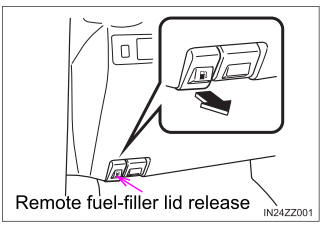
To open the fuel-filler lid, pull the remote fuel-filler lid release.

Copyright © 2026 www.toyaris4.com