
Toyota Yaris: Front Door Speaker / Components
COMPONENTS
ILLUSTRATION
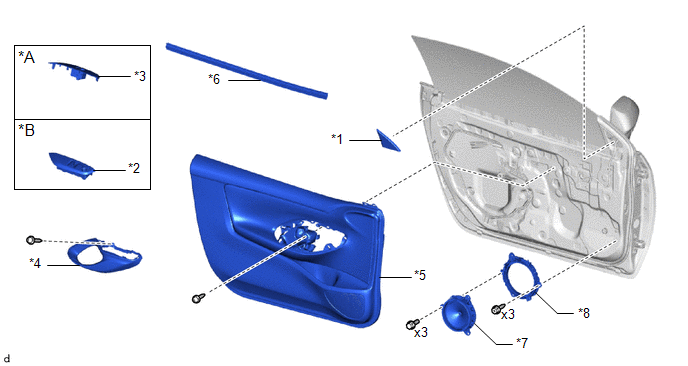
| *A | for Front Passenger Side | *B | for Driver Side |
| *1 | FRONT DOOR LOWER FRAME BRACKET GARNISH | *2 | MULTIPLEX NETWORK MASTER SWITCH ASSEMBLY WITH FRONT ARMREST BASE UPPER PANEL |
| *3 | POWER WINDOW REGULATOR SWITCH ASSEMBLY WITH FRONT ARMREST BASE UPPER PANEL | *4 | FRONT DOOR TRIM GARNISH |
| *5 | FRONT DOOR TRIM BOARD SUB-ASSEMBLY | *6 | FRONT DOOR GLASS INNER WEATHERSTRIP |
| *7 | FRONT NO. 1 SPEAKER ASSEMBLY | *8 | FRONT NO. 1 SPEAKER BRACKET |

 Removal
REMOVAL CAUTION / NOTICE / HINT HINT:
Use the same procedure for the RH and LH sides.
The procedure listed below is for the LH side.
PROCEDURE 1...
Other information:
Toyota Yaris XP210 (2020-2026) Reapir and Service Manual: Removal
REMOVAL CAUTION / NOTICE / HINT The necessary procedures (adjustment, calibration, initialization or registration) that must be performed after parts are removed and installed, or replaced during fuel pressure sensor removal/installation are shown below...
Toyota Yaris XP210 (2020-2026) Owner's Manual: Fuel Economy Monitor (If equipped)
The Fuel Consumption information is displayed by operating each icon in the display. In addition, after completing a trip, the total energy efficiency to date is displayed in the ending display when the ending display is turned on. Select the icon on the home screen to display the Applications screen...
Categories
- Manuals Home
- Toyota Yaris Owners Manual
- Toyota Yaris Service Manual
- Diagnostic Trouble Code Chart
- Key Battery Replacement
- Headlights
- New on site
- Most important about car
Break-In Period
No special break-in is necessary, but a few precautions in the first 600 miles (1,000 km) may add to the performance, economy, and life of the vehicle.
Do not race the engine. Do not maintain one constant speed, either slow or fast, for a long period of time. Do not drive constantly at full-throttle or high engine rpm for extended periods of time. Avoid unnecessary hard stops. Avoid full-throttle starts.
Copyright © 2026 www.toyaris4.com