
Toyota Yaris: Engine Coolant Temperature Sensor / Components
COMPONENTS
ILLUSTRATION
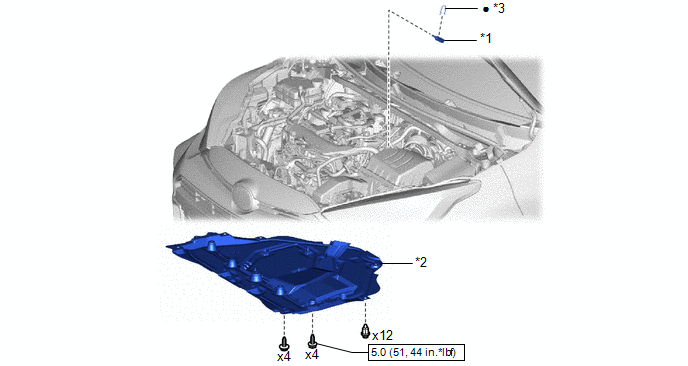
| *1 | COOLANT TEMPERATURE SENSOR | *2 | NO. 1 ENGINE UNDER COVER ASSEMBLY |
| *3 | CLIP | - | - |
 | N*m (kgf*cm, ft.*lbf): Specified torque | ● | Non-reusable part |

 Inspection
INSPECTION PROCEDURE 1. INSPECT ENGINE COOLANT TEMPERATURE SENSOR CAUTION:
Do not put your hands into the water that has been heated for the inspection...
Other information:
Toyota Yaris XP210 (2020-2026) Reapir and Service Manual: Diagnostic Trouble Code Chart
DIAGNOSTIC TROUBLE CODE CHART Power Steering System DTC No. Detection Item DTC Detection Condition Warning Indicate Return-to-normal Condition Note Link C05D604 Power Steering Control Module Processor System Internal Failure ECU internal malfunction (CPU malfunction) EPS warning light: Comes on Ignition switch ON again - C05D646 Power Steering Control Module Processor Calibration / Parameter Memory Failure ECU internal malfunction (EEPROM error) EPS warning light: Comes on Ignition switch ON again - C05D649 Power Steering Control Module Processor Internal Electronic Failure ECU internal malfunction (Peripheral circuit malfunction) EPS warning light: Comes on Ignition switch ON again - C10001C Control Module Internal Temperature Sensor "A" Circuit Voltage Out of Range ECU temperature sensor "A" range malfunction EPS warning light: Comes on The ECU judges the system has returned to normal - C123A17 Supply Voltage Circuit Circuit Voltage Above Threshold IG voltage is 18...
Toyota Yaris XP210 (2020-2026) Reapir and Service Manual: Brake Override System
DESCRIPTION When the vehicle is being driven, depressing the accelerator pedal sensor assembly and brake pedal will activate the brake override system to restrict engine output. The conditions for activating the brake override system as well as the items that are controlled are explained below...
Categories
- Manuals Home
- Toyota Yaris Owners Manual
- Toyota Yaris Service Manual
- Auto Lock/Unlock Function
- Engine & Hybrid System
- How to connect USB port/Auxiliary jack
- New on site
- Most important about car
Break-In Period
No special break-in is necessary, but a few precautions in the first 600 miles (1,000 km) may add to the performance, economy, and life of the vehicle.
Do not race the engine. Do not maintain one constant speed, either slow or fast, for a long period of time. Do not drive constantly at full-throttle or high engine rpm for extended periods of time. Avoid unnecessary hard stops. Avoid full-throttle starts.
Copyright © 2026 www.toyaris4.com