Toyota Yaris: Start/Stop Engine / Ignition Switch
Push Button Start Positions
The system operates only when the driver is in the vehicle or within operational range while the key is being carried.
Each time the push button start is pressed, the ignition switches in the order of off, ACC, and ON. Pressing the push button start again from ON switches the ignition off.

Off
The power supply to electrical devices turns off and the push button start indicator light (amber) also turns off.
In this position the steering wheel is locked.
ACC (Accessory)
Some electrical accessories will operate and the indicator light (amber) illuminates.
ON
This is the normal running position after the engine is started. The indicator light (amber) turns off. (The indicator light (amber) illuminates when the ignition is switched ON and the engine is not running.)
Some indicator lights/warning lights should be inspected before the engine is started.
Push Button Start Positions
- The engine starts by pressing the push button start while depressing the clutch pedal (manual transaxle) or the brake pedal (automatic transaxle). To switch the ignition position, press the push button start without depressing the pedal.
- Do not leave the ignition switched ON while the engine is not running. Doing so could result in the battery going dead. If the ignition is left in ACC (For automatic transaxle, the selector lever is in the P position, and the ignition is in ACC), the ignition switches off automatically after about 25 minutes.
ACC (Accessory)
The keyless entry system does not function while the push button start has been pressed to ACC, and the doors will not lock/unlock even if they have been locked manually.
ON
When the push button start is pressed to ON, the sound of the fuel pump motor operating near the fuel tank can be heard. This does not indicate an abnormality.
WARNING
Before leaving the driver’s seat, set the parking brake, make sure the selector lever is in 1st gear or R (manual transaxle) or in P (automatic transaxle), and always switch the ignition off
Leaving the driver’s seat without setting the parking brake, shifting the selector lever to 1st gear or R (manual transaxle) or to P (automatic transaxle), and switching the ignition off is dangerous. Unexpected vehicle movement could occur which could result in an accident.
In addition, if your intention is to leave the vehicle for even a short period, it is important to switch the ignition off, as leaving it in another position will disable some of the vehicle’s security systems and run the battery down.

 Starting the Engine
Make sure you are carrying the key.
Occupants should fasten their seat belts.
Make sure the parking brake is on.
Continue to press the brake pedal firmly until the engine has completely
started...
Other information:
Toyota Yaris XP210 (2020-2026) Reapir and Service Manual: Backup Boost Converter "A" Control CPU Signal Invalid (P060629)
DESCRIPTION The engine stop and start ECU can detect open circuits when signals such as the boost, standby request or overheating signal cannot be sent to the backup boost converter control IC from the stop and start control IC in the engine stop and start ECU...
Toyota Yaris XP210 (2020-2026) Reapir and Service Manual: Engine Difficult to Start
DESCRIPTION Problem Symptom Suspected Area Trouble Area Engine does not crank Engine cranks slowly Auxiliary battery depletion Starter malfunction Starter system Auxiliary battery depletion Starter malfunction Starter circuit Excessive engine friction Engine Engine assembly Starting time is long Engine speed fluctuation due to abnormal combustion Idle speed too low or high The engine stalls immediately after starting Strong engine vibration due to above symptoms Ignition malfunction Deviation in air fuel ratio (Excessive or insufficient intake air volume or fuel supply) Insufficient compression Changes in load from another system Ignition system Spark plug Ignition coil assembly Fuel system Direct fuel injector assembly Port fuel injector assembly Fuel pump assembly (for high pressure side) Fuel pump (for low pressure side) Fuel pump control circuit Fuel suction plate sub-assembly Fuel main valve assembly Fuel line Purge VSV system Fuel quality (existence of foreign matter, degradation) Intake and exhaust systems Mass air flow meter sub-assembly Intake system (Air leaks or deposit accumulation) Throttle body with motor assembly Air fuel ratio sensor (sensor 1) Air fuel ratio sensor (sensor 2) Cam timing oil control solenoid assembly Variable Valve Timing system (VVT system) Other control systems ECM Wire harness or connector Knock control sensor Engine coolant temperature sensor Immobiliser system Engine Water control valve Engine assembly Crankshaft position sensor High load from another system Air conditioning system Power steering system Electrical load signal system SYMPTOM AND CAUSE OF SYSTEM MALFUNCTION HINT: The following are descriptions of the characteristics of each system malfunction...
Categories
- Manuals Home
- Toyota Yaris Owners Manual
- Toyota Yaris Service Manual
- Immobilizer System
- G16e-gts (engine Mechanical)
- Engine & Hybrid System
- New on site
- Most important about car
Keys
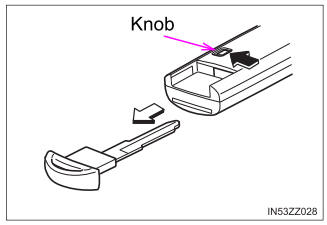
To use the auxiliary key, press the knob and pull out the auxiliary key from the smart key.